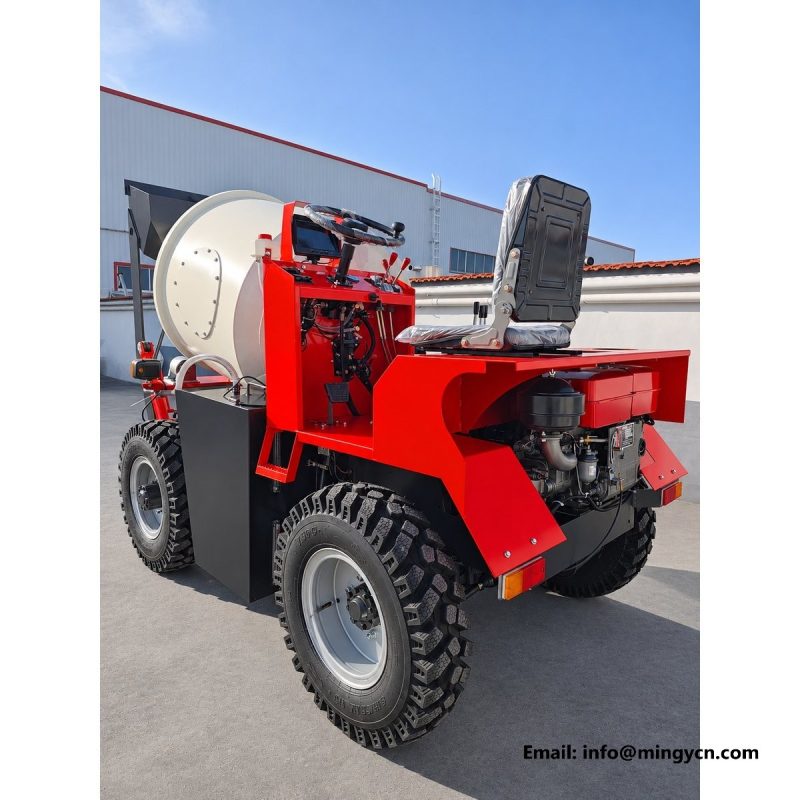
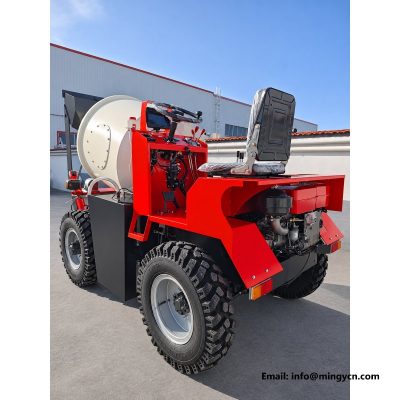
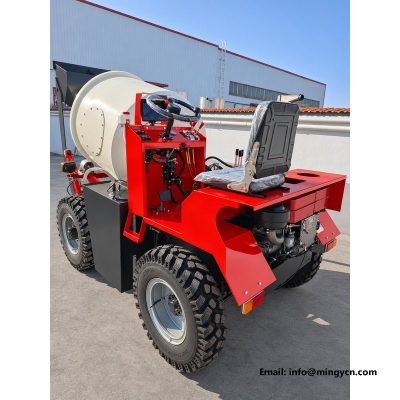
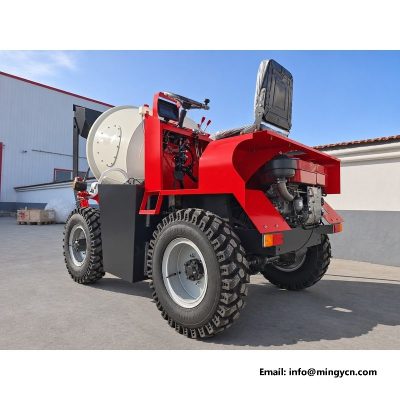
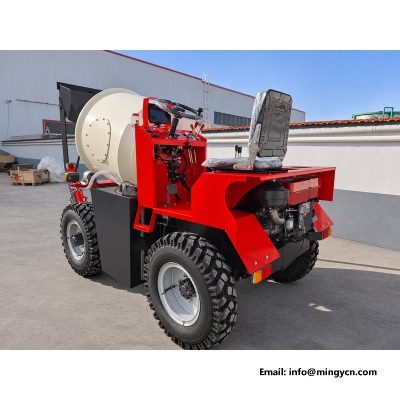
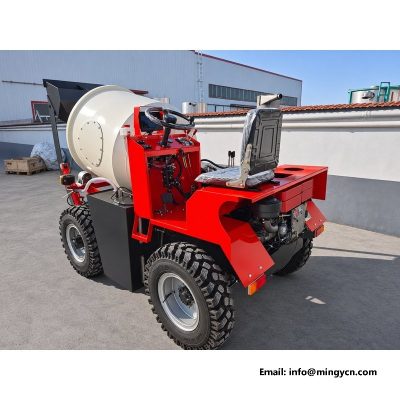
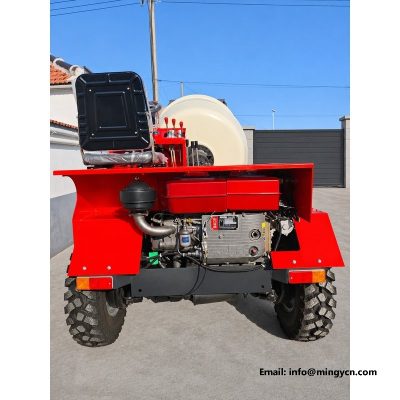
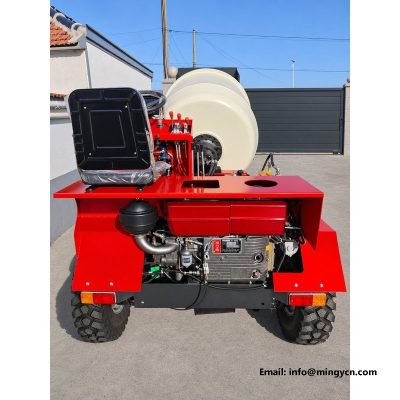
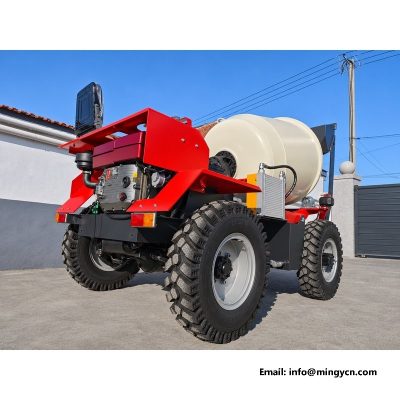
rear quarter: engine bay, cooling pack and rear axle
The back of a self-loading mixer is where the working parts live and where buyers look least. This set was taken from both rear corners and from directly behind, with the drum in its parked position, and it covers the engine bay, the cooling pack, the 130 rear axle and the frame tail on the 1.5 m3 machine. The approach matches the front pages but the questions differ: not how the load enters, but how the machine sheds heat, steers from the rear and survives being reversed into a pile. Read these sections in the order the photographs appear, and read the axle before the paint.
| Specification | 1.5 m³ self loading mixer |
|---|---|
| Operating weight | 1,900 kg |
| Rear axle | 130 four-wheel steering |
| Engine | Single-cylinder diesel, 25 hp |
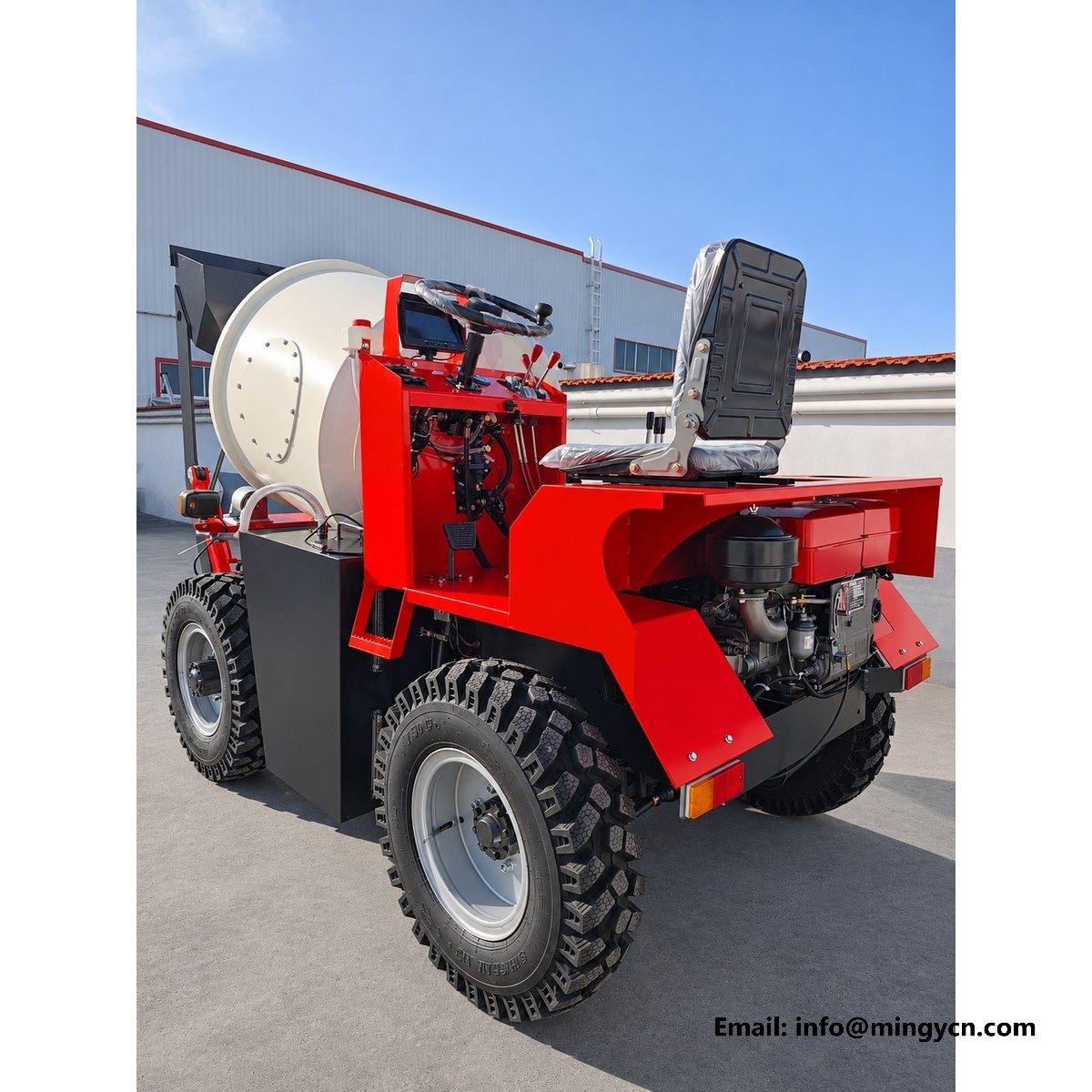
Front and side views show what the machine presents to the world. The rear quarter shows what it keeps to itself. Engine bay, cooling pack, rear axle and frame tail all live behind the drum, and they are the assemblies that decide whether the machine keeps working through a hot afternoon. A rear three-quarter frame also shows the true length of the machine against the drum, which is the quickest way to judge whether the tail swings clear of a wall when the rear axle steers. This set was shot from both rear corners and from directly behind. Taken slightly low, the tail, the axle and the bay opening line up in one frame. A rear quarter that hides the engine bay was framed to hide something, so treat the open version as the honest one.
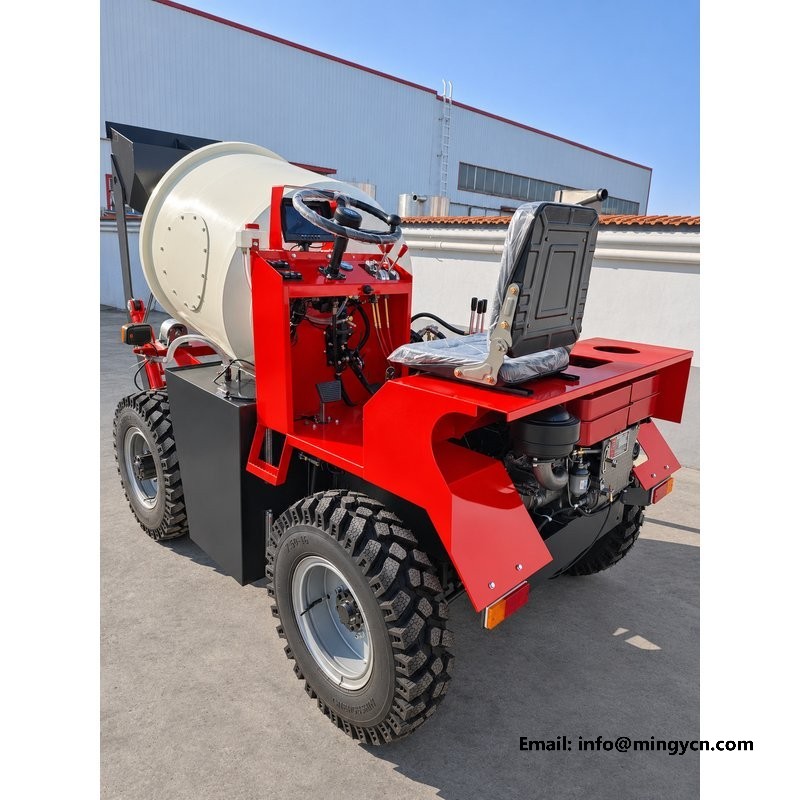
Look at the size of the opening before you look inside it. A bay that can be reached with one hand and a torch is a bay that gets checked. A bay closed down to a grille is a bay that gets checked when it fails. On this machine the rear quarter shows a side opening at frame height and a top access panel above the engine, which between them reach the oil filler, the filters and the battery. Check that panel edges are folded rather than left as cut sheet, because a raw edge on an access panel is a cut hand waiting to happen. A panel that must be unbolted and set aside usually ends up leaning against the drum.
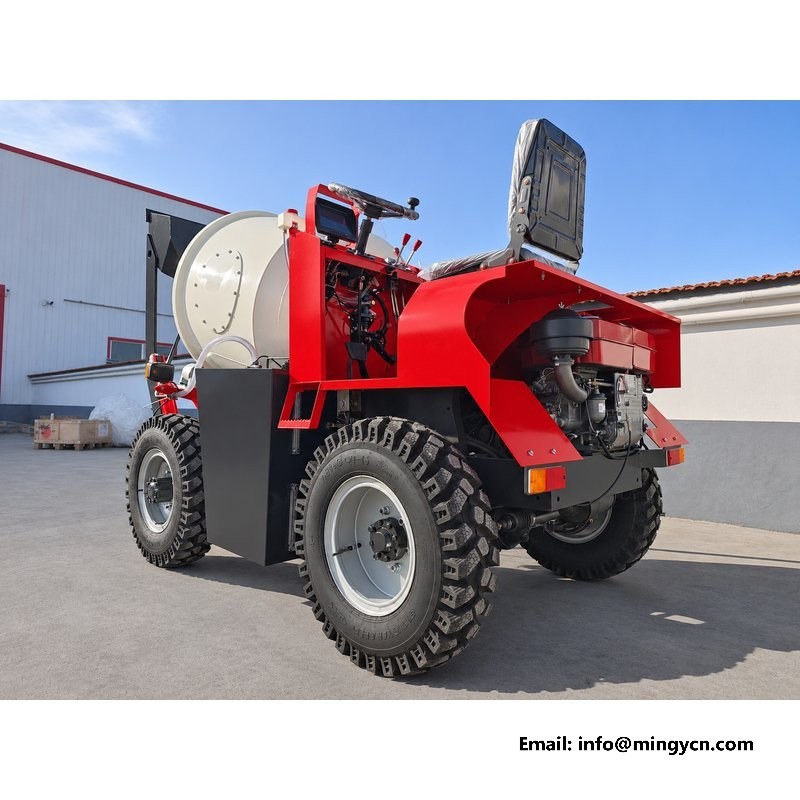
A single-cylinder diesel of 25 hp is a deliberate choice at this size: simple, repairable almost anywhere, and matched to a hydraulic system that does not ask for more. From the rear quarter you can see how the engine sits in its bed, and the answer should be rubber isolators rather than metal bolted to metal. Look at the bed rails. They should run fore and aft and tie into a crossmember, not float on the drum saddle. Exhaust and air intake should both leave the bay without passing close to a hose. Rubber mounts also isolate the frame from the firing stroke, which is the difference between a tight machine and one that loosens bolts. Check the air cleaner position too, because a filter that sits low behind the axle breathes mud on a wet site.
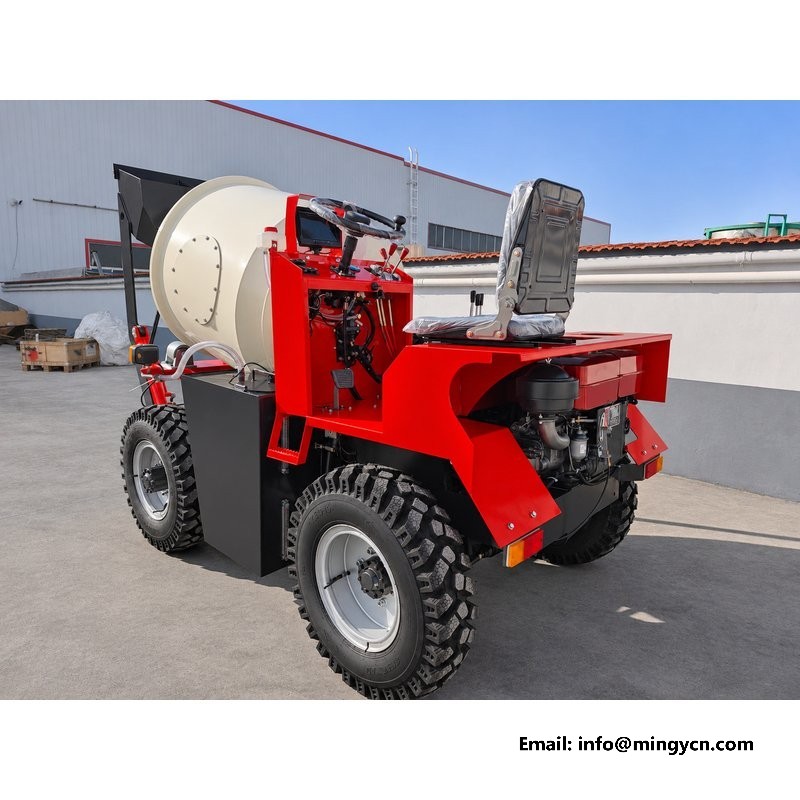
The cooling pack on a mixer works in the worst place available: behind a drum that throws dust and ahead of an axle that throws mud. In the rear photographs, check the radiator core for fin straightness and for a shroud that seals the fan to the core. Without a shroud the fan pulls air from around the core rather than through it, and the engine runs hot at low speed when the hydraulic load is highest. Look also at the gap between fan and core, and at whether the grille comes off without tools. A core washed from the wrong side has flattened fins, and flattened fins cannot be straightened back to full flow. A missing shroud is easy to spot, because the fan then sits in open air with a visible gap all round the core.
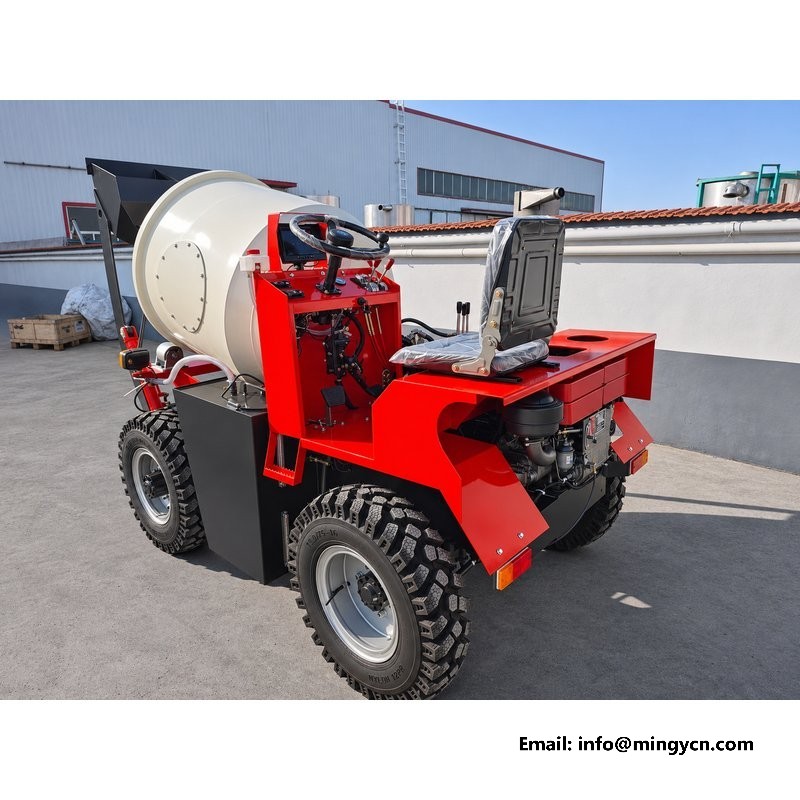
Directly behind the machine, the rear axle is a study in what four-wheel steering costs in parts. The 130 axle carries a steering arm at each end and a linkage that has to stay clear of the frame through the full 28 degree swing. In the photograph, look for the steering ram mounted above the axle tube where it is protected, and for track rod ends sitting behind the axle line rather than ahead of it, where a stone would find them first. Check that the axle breather is piped upward, because a submerged breather turns a hot axle into a water tank. Look also at the welds where the brackets meet the tube, because those joints work in both directions.
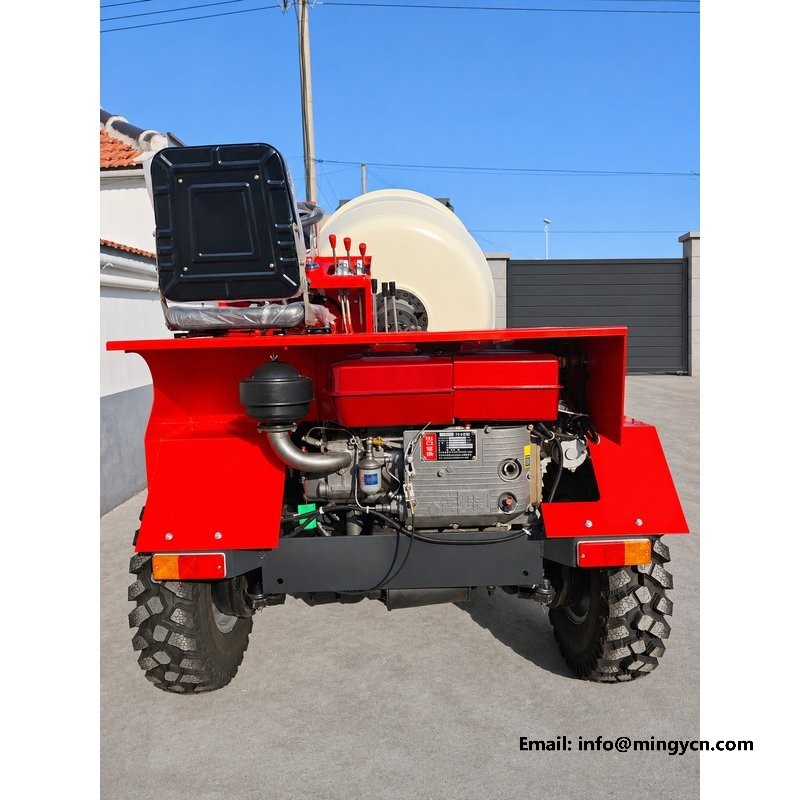
The section of frame behind the rear axle is short on this machine, and the rear photographs show how it closes. A crossmember should tie the two rails together at the tail, with the axle mounting plates landing on it rather than on the rail web alone. Look for lifting eyes or marked jack points, and for a tail cut square rather than left open, because an open rail end collects water and rusts from the inside out. At a 1,900 kg operating weight, the tail is also where a forklift is most likely to be applied. A tail closed with a plate keeps the rail ends out of the mud, where corrosion is slowest to find. Check the bolts that hold the crossmember to the rails, because a tail welded only at its ends works loose in the middle.
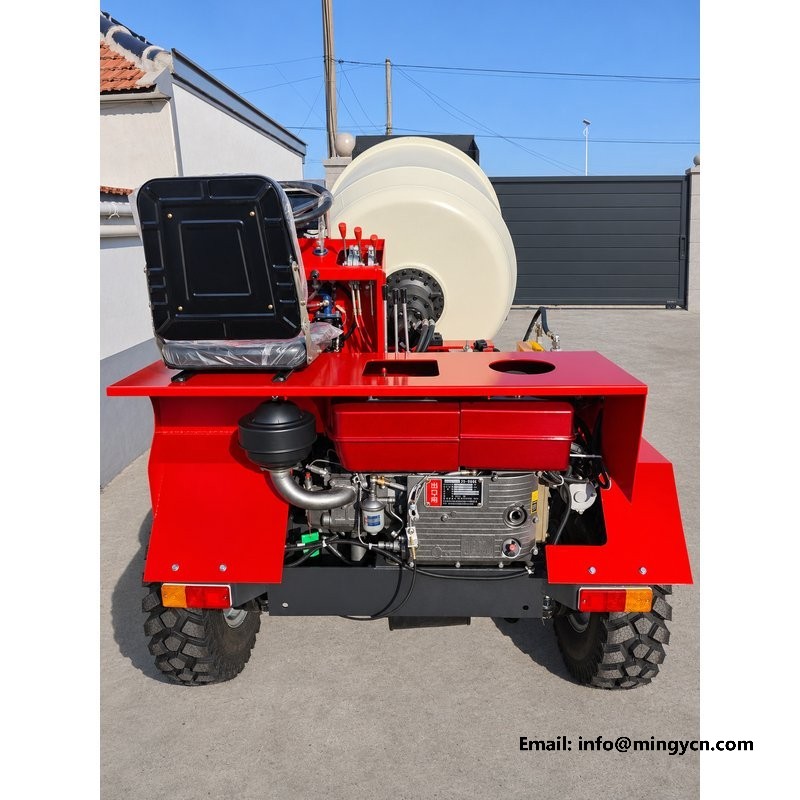
Rear lighting on a site machine is a legal detail and a practical one. The photographs should show a pair of lamps set into a protected recess rather than hanging on brackets, with the wiring entering from below so water runs off instead of in. Reflectors belong at the widest point, which on this machine is the outer edge of the tyre line rather than the centre of the tail. Check that the lenses sit behind a guard or inside the frame envelope, because the first thing a reversing mixer meets is often a wall or a stack of blocks. Wiring should run inside the frame, not along its outer face. A single lamp in the centre of the tail is a compromise, and it leaves one side of the machine unlit when reversing at an angle.
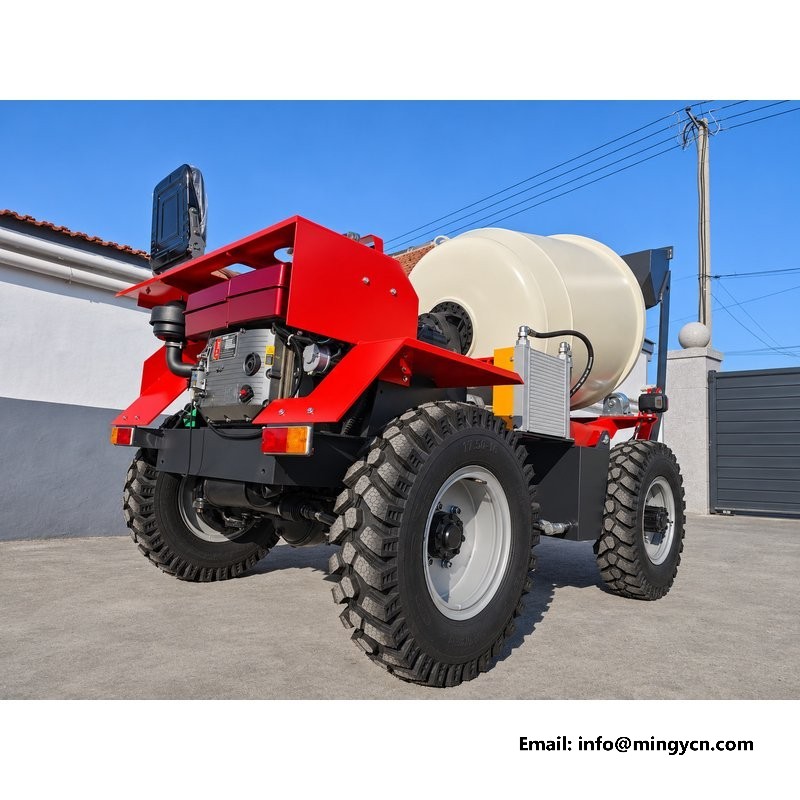
Follow the exhaust from the engine to its outlet in the rear photographs. The route should climb and exit away from the drum, with a shield anywhere it passes within reach of a hand or a hose. On a machine that works at low speed all day, the exhaust stays hot for long periods, and a pipe running close to a hydraulic reservoir or a loom will cook it slowly rather than fail it suddenly. Look for a vertical outlet with a flap or a downward outlet that keeps rain out, and check that the pipe is supported at more than one point. A shield that is bolted rather than welded can be replaced when it rusts through. A pipe that leaves the bay horizontally and then turns upward is more likely to crack at the bend than one that rises straight from the manifold.
The rear quarter shows the departure angle better than any drawing. With a short tail behind the axle, this machine reverses over a kerb without dragging, which matters when the only way into a casting point is backward. Look at the lowest point at the tail and at how far it sits behind the tyre contact patch. Then look at what is exposed. A hose, a filter or a drain plug hanging below the frame line will be the first thing to meet a ramp. Check that height against the axle tube, because anything below the tube line is exposed the moment the machine reverses onto a ramp. Reverse onto a slope before you accept the machine, and listen for anything that touches before the tyres do.
Before the machine leaves the yard, the rear quarter gives you a compact inspection. Confirm the cooling pack is clean and the fan turns freely, that the engine bay panels latch without rattle, and that the rear axle steers lock to lock without the linkage touching anything. Check the lamps, the reflectors and the warning beacon if one is fitted, and look for oil weeping at the axle ends and hub seals. Finally, confirm the tail lamps are visible from both rear corners with the drum in its parked position. Write the findings down and photograph them, because a sound rear end is the easiest part to keep sound. A rear end checked properly at delivery needs nothing more than a weekly look for the rest of its working life.
At 25 hp it is matched to the hydraulic demand of a 1.5 m3 drum and a loader that works one function at a time. A single cylinder gives fewer parts to fail, easier field repair and a lower centre of gravity than a multi-cylinder of the same output. The trade-off is vibration, which is why the engine bed and the exhaust mounting matter as much as the rating. Photographs of the bay show whether those mounts were designed or improvised.
It should look protected. The 130 four-wheel-steering axle needs its steering arms and linkage clear of the frame through the full 28 degree swing, and the ram should sit above or behind the axle tube rather than below it, where a rut or a stone can reach. The breather should be piped upward and the hub seals should be dry. If a rear photograph shows linkage hanging below the axle line, ask why before you accept the machine.
For the current specification, build options and a formal quotation for your market, contact MINGYI Machinery. E-mail: sales@mingycn.com | LINE (ID): mingyicn
Engine Bay, Radiator and Cooling Airflow on the 1.5m3 Mixer · Welded Chassis Frame on the 1.5m3 Self Loading Mixer · 1.5m3 Self Loading Mixer from Every Angle: A Yard Photo Reference









