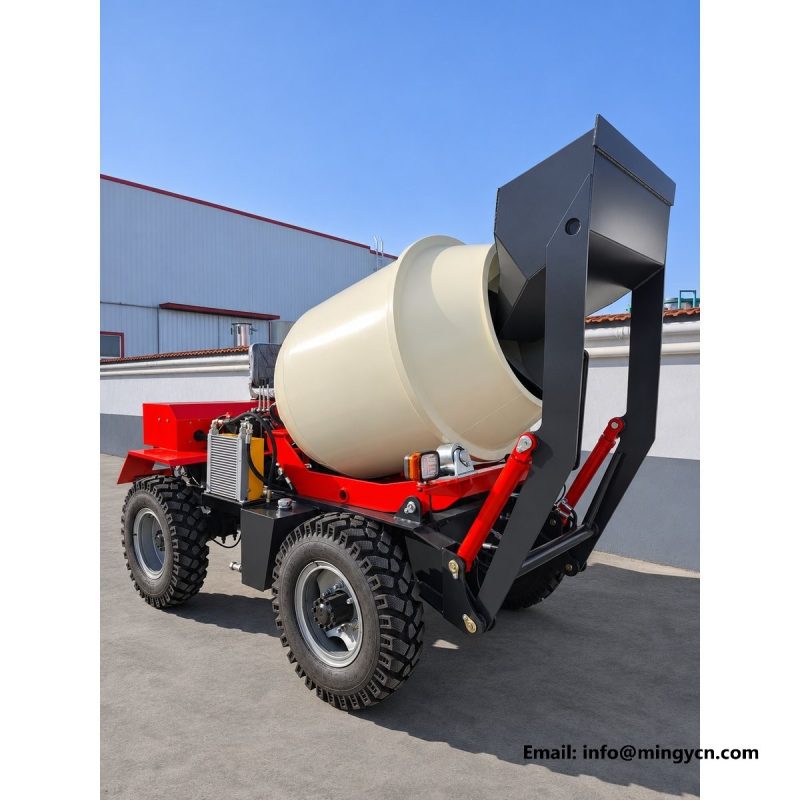
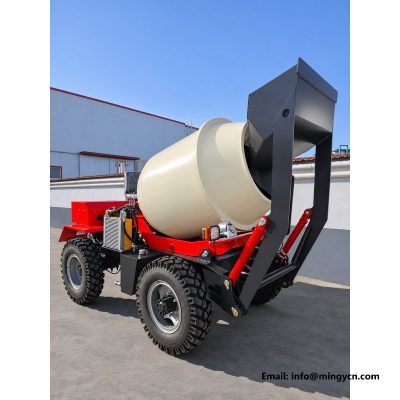
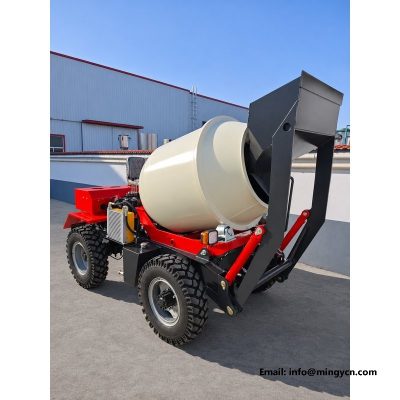
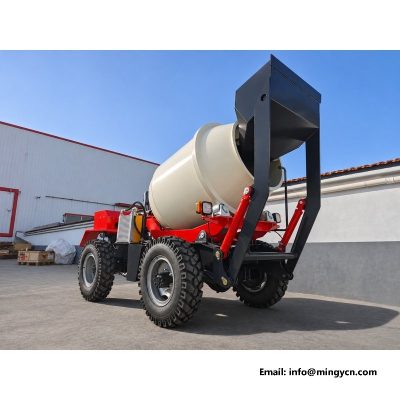
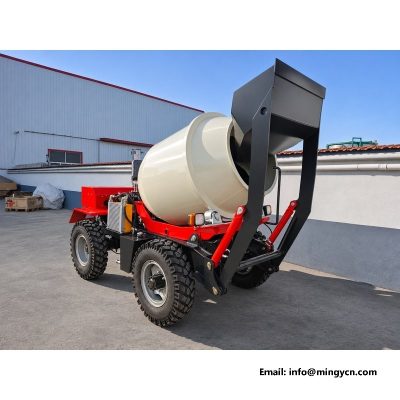
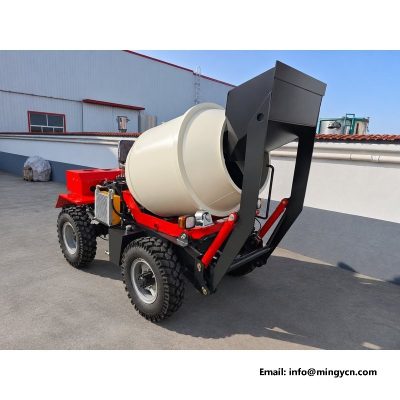
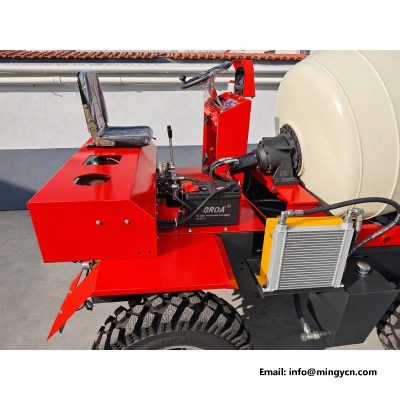
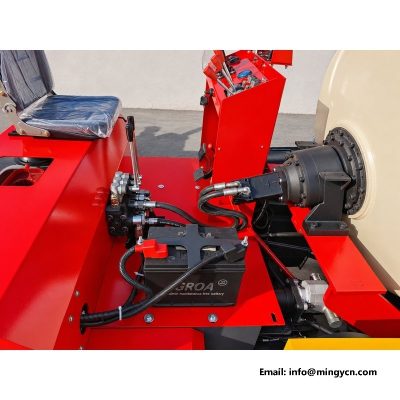
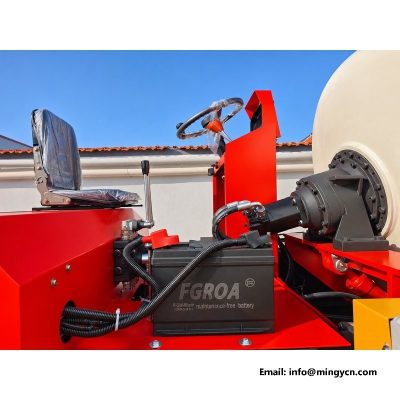
operator side: fuel tank, steps and hand rails
The last set in this gallery stands where the operator stands. Fuel, steps, hand rails and the platform are not the parts buyers compare on a specification sheet, but they decide how the machine behaves at six in the morning with a cold engine and a full day ahead. These photographs work up the operator side of the 1.5 m3 machine from the ground to the platform, with the 1,600 mm body width as the constraint that shapes every one of those details. Read them as a workplace rather than as a product, and read the steps before the levers.
| Specification | 1.5 m³ self loading mixer |
|---|---|
| Operating weight | 1,900 kg |
| Overall dimensions (L x W x H) | 3,500 x 1,600 x 2,200 mm |
| Steering | Hydraulic power steering |
Every other page in this set looks at the machine as an object. This one looks at it as a place where somebody stands for most of a working day. The operator side is where the fuel goes in, where the boots land and where the hands reach, and those three things decide how quickly a machine can be started in the morning and how tired the operator is by the afternoon. On this build the platform, the tank and the steps sit inside the 1,600 mm body width, which keeps the walkway tight and keeps the machine narrow. The figures that matter here are not on the sheet: first step height, reach to the cap, walkway width. A machine that is easy to mount is a machine that gets checked before the first load rather than after the first breakdown.
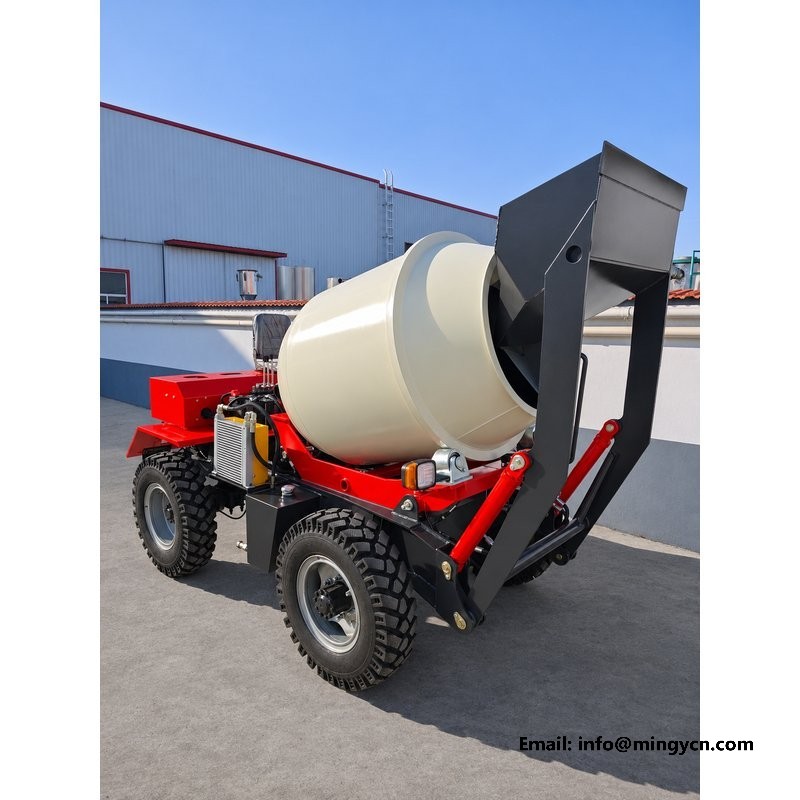
The tank sits behind the front wheel on the operator side, low in the frame and inboard of the tyre line. That position keeps the centre of gravity down and keeps the tank out of the path of the hopper, but it also puts it in the spray path of the front tyre, which is why the filler cap matters. Look for a cap with a seal and a retaining chain, and for a neck that rises above the tank top so a full tank does not weep on a slope. A filler set flush with the tank surface will spill the first time the machine leans. A low tank also keeps the filler clear of the hopper arm. A tank with a drain plug at its lowest corner can be emptied for a filter change without spilling diesel over the frame.
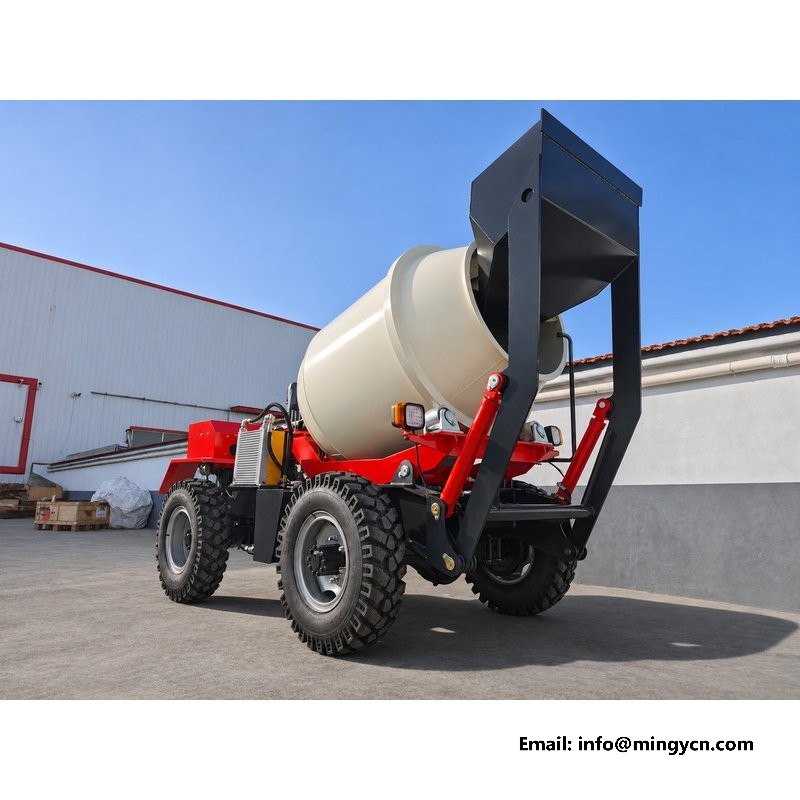
The height of the filler neck decides how fuel gets in. A neck at platform level can be filled from a can or a pump without anyone standing on the machine, which is the difference between a safe refuel and a climb with a full container. In the photographs, judge the distance from ground to cap and the space around it for a spout or a nozzle. Check also that the cap does not sit directly under the drum or the hopper arm, where a drip would land on hot steel or on the operator's boots during the next lift. Judge the neck by whether a standard spout fits without a funnel held in one hand. A neck angled toward the walkway is easier to fill than one that points at the tyre, and the difference shows on a wet day.
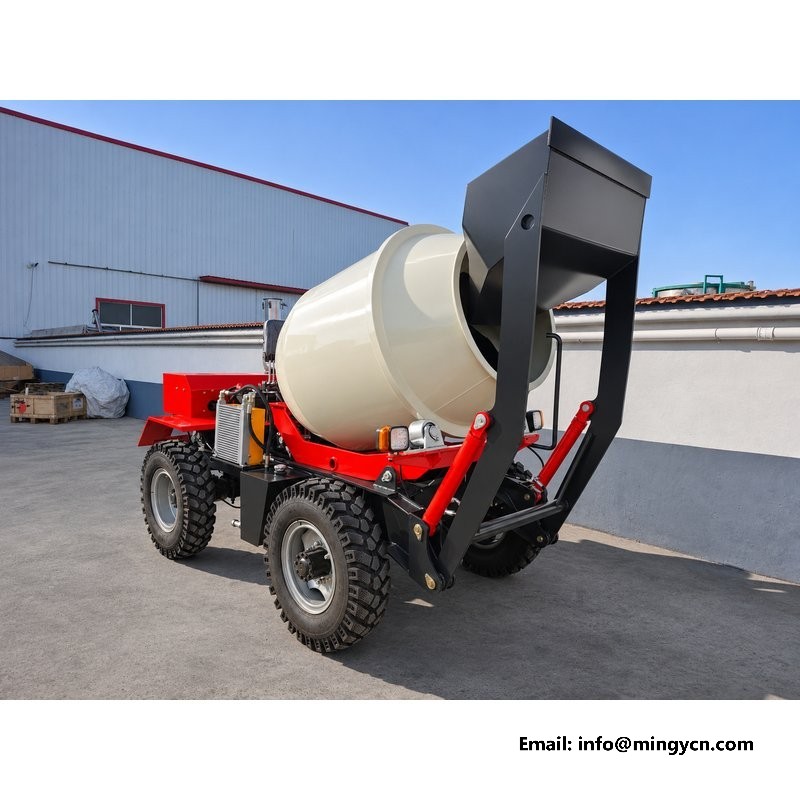
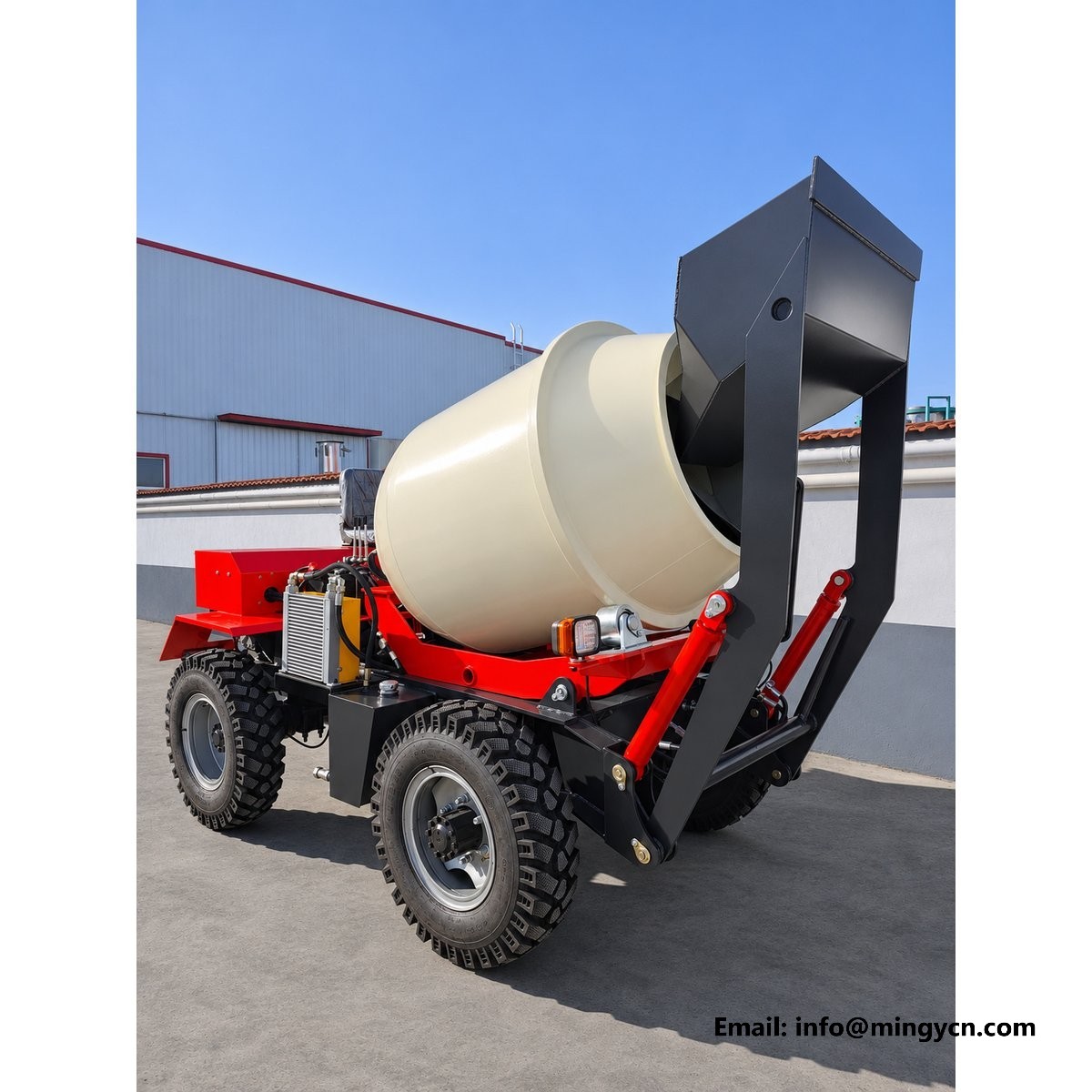
Steps are the most used and least specified part of a mixer. The first step should sit at a height a boot can reach without a hop, and each tread should be deep enough for the whole foot, with a raised edge or a perforated surface for grip. In the side photographs, look at the spacing between treads. An even rhythm is easier to climb than a short step followed by a tall one, especially with muddy boots. Check how the steps are fixed. Welded to the frame is stronger, bolted is replaceable, and a step welded to a thin bracket will bend. Flat plate treads become a slide in wet weather. Ask for the distance from ground to the first tread in writing, because it is the one step measurement a buyer can compare across machines.
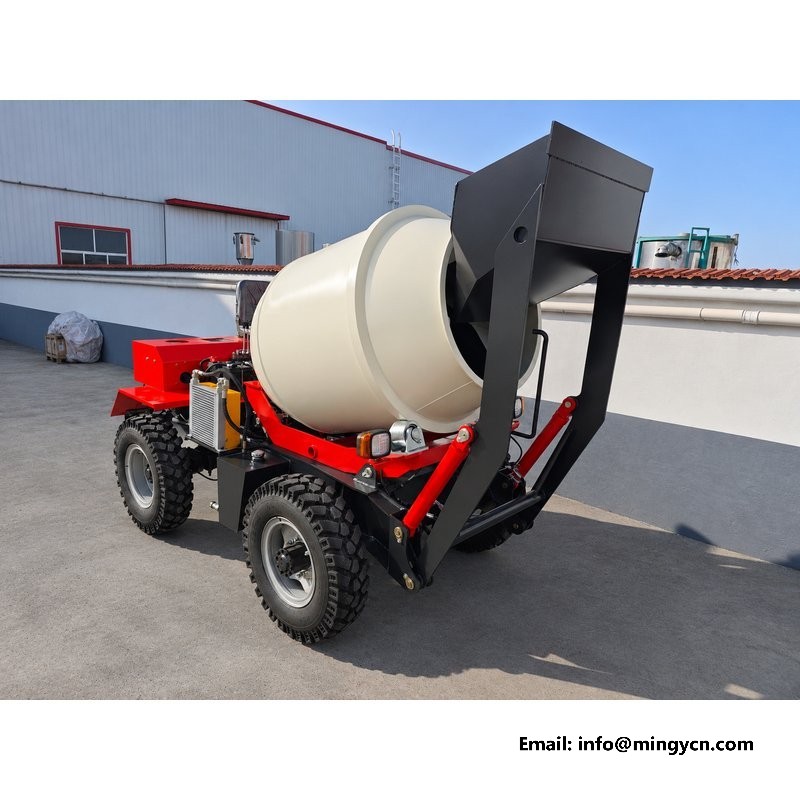
A hand rail exists so the operator can keep three points of contact while climbing, and its position matters more than its thickness. It should run above the top step and continue onto the platform, so there is no point where the hand has to let go and reach. In the operator side photographs, check that the rail stays clear of the drum guard and the hopper arm through the full lift arc, and that the ends are capped rather than left open. A rail that stops at the platform edge stops exactly where balance is hardest to keep. A rail bolted through the frame rather than welded to a bracket can be replaced when it bends. A rail set too far from the steps forces the operator to lean back, and leaning back on a ladder is how ankles are lost.
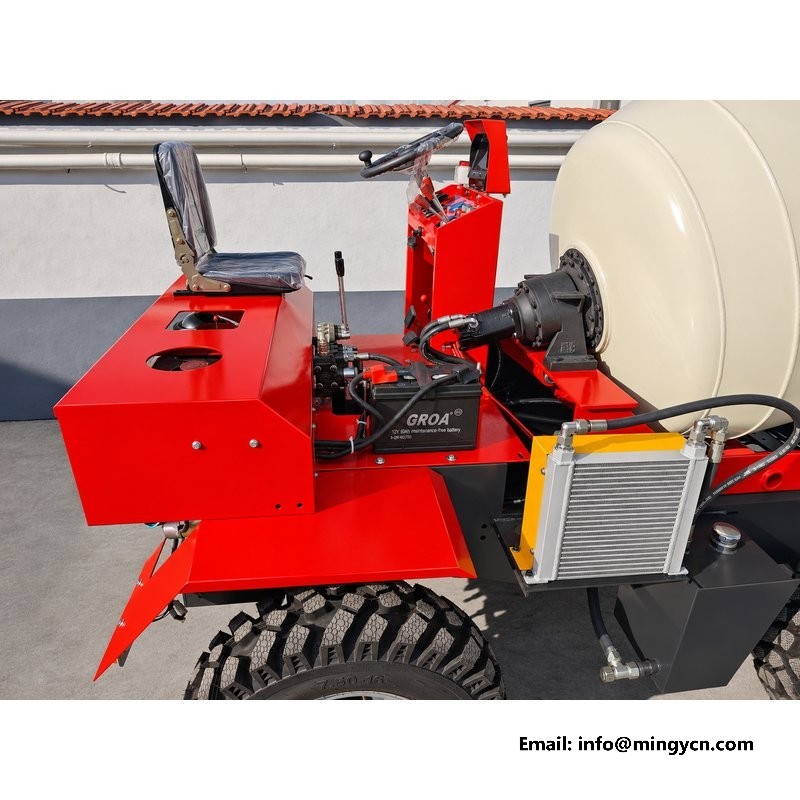
The platform is small at this size, and every control has to earn its place. With hydraulic power steering, the effort at the wheel stays low through a full lock, which matters where the operator turns the machine repeatedly in a tight casting area. In the photographs, look at the reach from the seat to the levers, at whether the steering column is adjustable, and at whether the floor is flat enough to clear mud off a boot without trapping it. A platform that collects material becomes a platform that holds water, and water finds the harness. A floor with a lip and a drain hole sheds water instead of holding it. Check that the levers fall to hand without the operator twisting, because a reach that feels long on the first day is a strain by the end of a season.
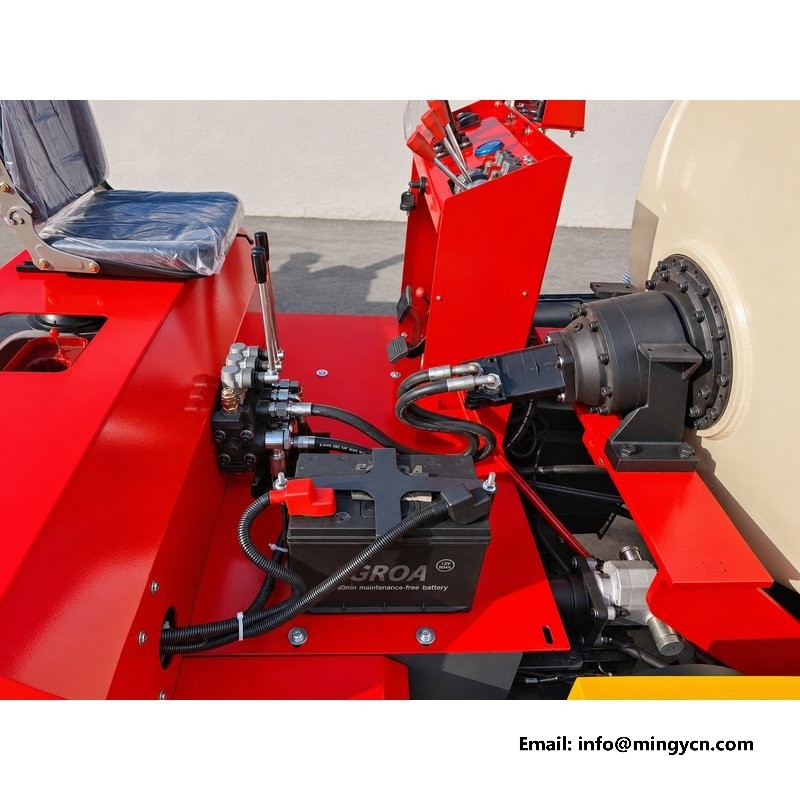
Every mixer carries small items that have no home: the grease gun, a spare pin, the wrench for the drum bolts, a bag of cement between loads. The operator side is where they end up, and the machine should offer a place for them that is not the floor. In the photographs, look for a tray or a locker formed into the frame, for a bracket that holds a grease gun upright, and for a flat surface where a clipboard can sit. Storage designed in at build time costs almost nothing. A locker with a lid beats an open tray, because an open tray fills with dust and passes it on. A bracket for a water bottle and a hook for a jacket are small things, but they decide whether the platform stays tidy by the end of a shift.
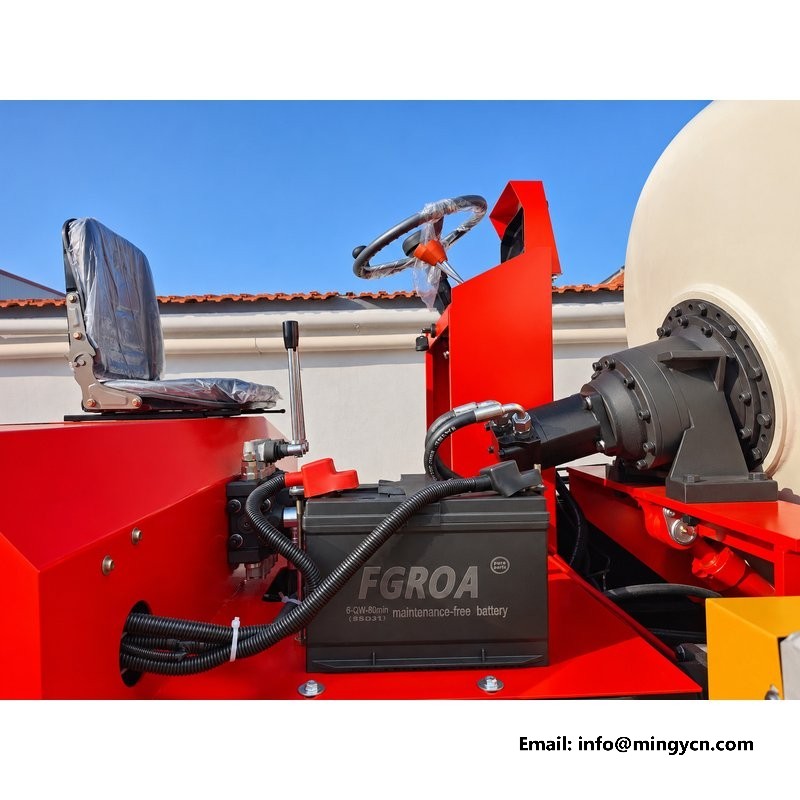
Daily checks should be possible from one place. On this machine the engine oil, the hydraulic tank and the battery are reachable from the operator side or from the adjacent rear corner, so a morning check does not require walking round the machine twice. In the photographs, confirm that the dipstick and the filler caps are not buried under the platform, and that the hydraulic level plug can be read without removing a panel. A machine that can be checked in one circuit gets checked. One hinged panel over the daily points is easier to live with than a spanner and three bolts. Counting the panels between the ground and the dipstick tells you more about daily maintenance than any service interval printed in a manual.
A single-cylinder diesel and a hydraulic system both make heat, and the operator side is where that heat arrives. In the photographs, look at what sits between the engine bay and the platform: a bulkhead, a shield or nothing at all. The exhaust and the hydraulic reservoir are usually the two sources, and a machine without a barrier between them and the operator's leg becomes unpleasant on a long pour. Noise follows the same path. Ask whether the platform has any absorption at all, and judge from the frames whether the engine bay opening faces the operator. A shield that stands off with an air gap works better than one fixed tight. Sit on the machine with the engine running before you buy, because heat and noise are the two things a photograph cannot report.
Start the daily walk-around at the steps and the rest of the machine follows a natural order. Check the treads and the rail first, then the fuel level and the cap seal, then the platform floor for spilled diesel. From there, walk forward along the operator side to the front wheel, checking the tyre and the hub, and continue round the front to the hopper. The route ends at the rear, where the engine bay and the cooling pack get their check. Done in the same order every morning, this circuit takes a few minutes. Walked in reverse at the end of the day, it catches the leaks that appear when everything is hot. A routine written down and kept with the machine survives a change of operator, which is more than most maintenance habits do.
On this machine it sits behind the front wheel on the operator side, low in the frame and inboard of the tyre line, which keeps the mass low and the filler reachable from the ground. The trade-off is exposure to spray from the front tyre, so the cap seal and the neck height are the details to check. The photographs in this set show both, and they show whether the tank sits in a cradle or hangs from straps.
Look at how they are attached rather than how thick they are. Steps welded to the frame through a gusset will take years of muddy boots; steps bolted to a thin bracket will bend the first time someone uses them as a ladder. The rail should run above the top step and continue onto the platform so the hand never has to let go. In the operator side frames, both the fixing and the rail run are visible.
For the current specification, build options and a formal quotation for your market, contact MINGYI Machinery. E-mail: sales@mingycn.com | LINE (ID): mingyicn
Operator Station: Steering, Seat and Control Levers on the 1.5m3 Mixer · 1.5 m3 Self Loading Concrete Mixer: Full Specification and Walkaround · 1.5m3 Self Loading Mixer from Every Angle: A Yard Photo Reference









