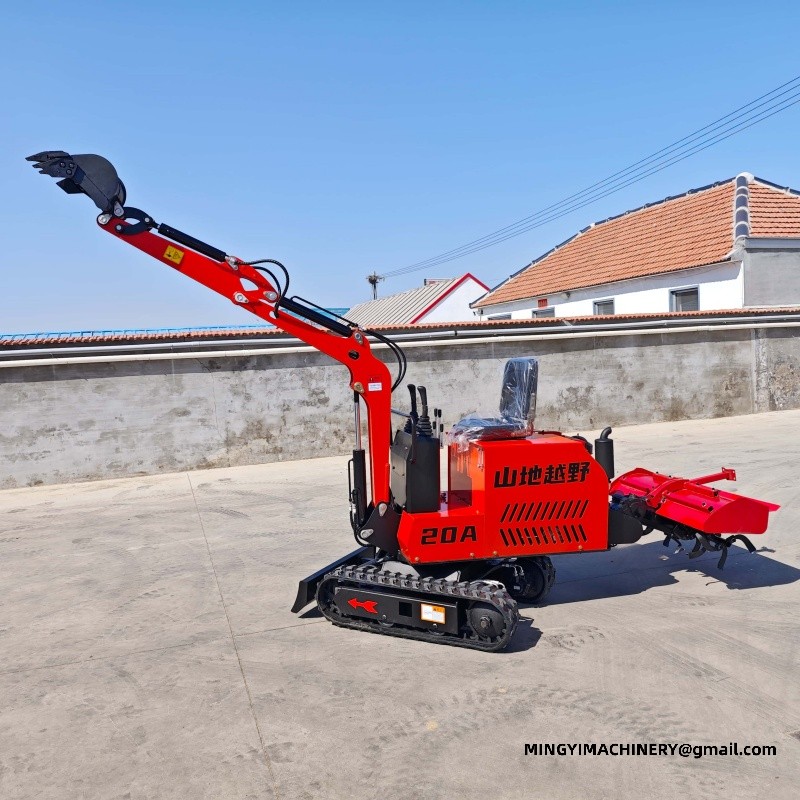
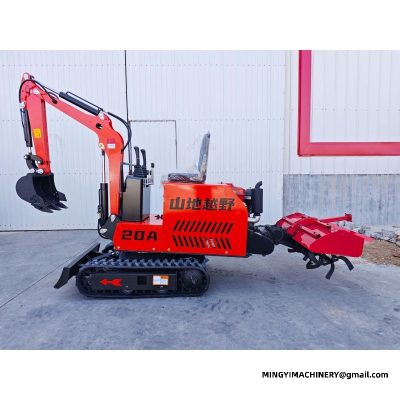
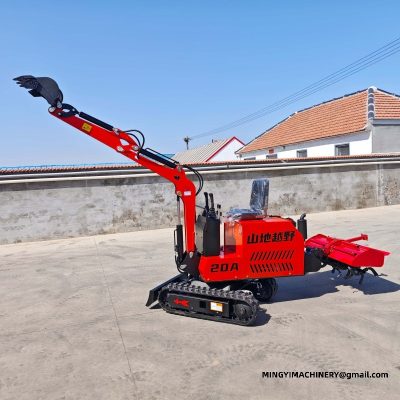
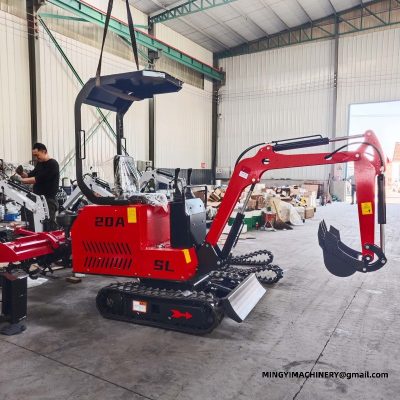
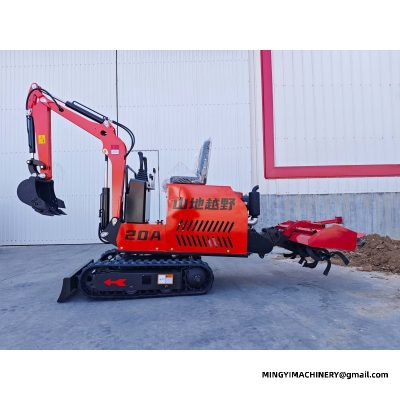
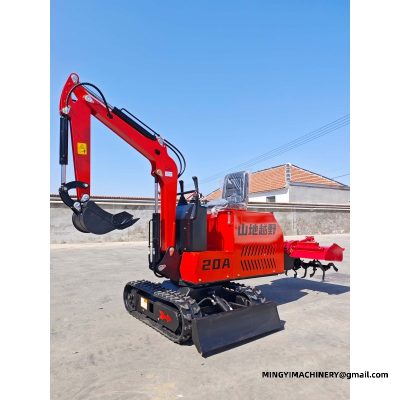
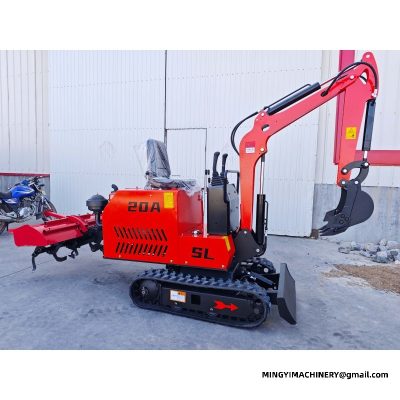
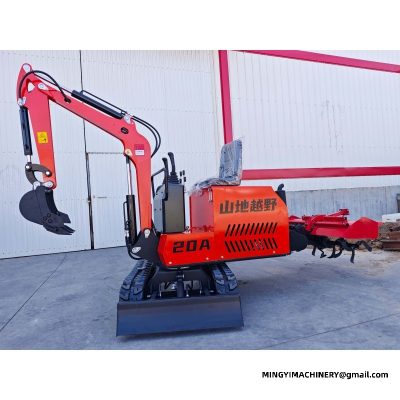
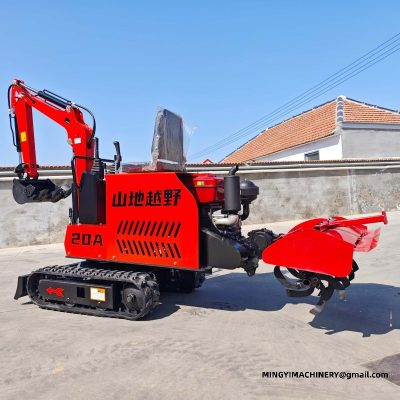
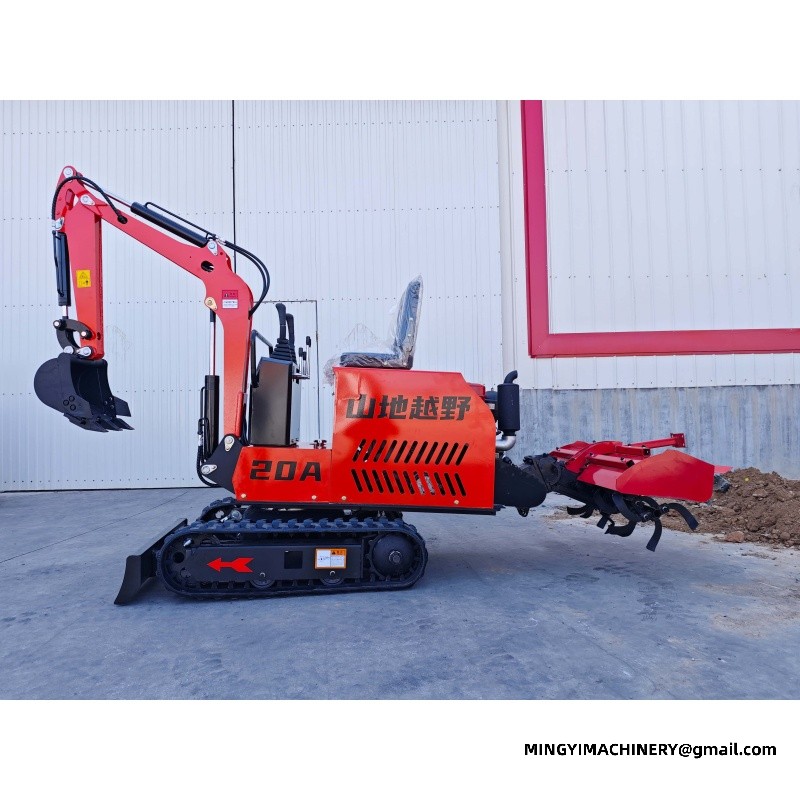
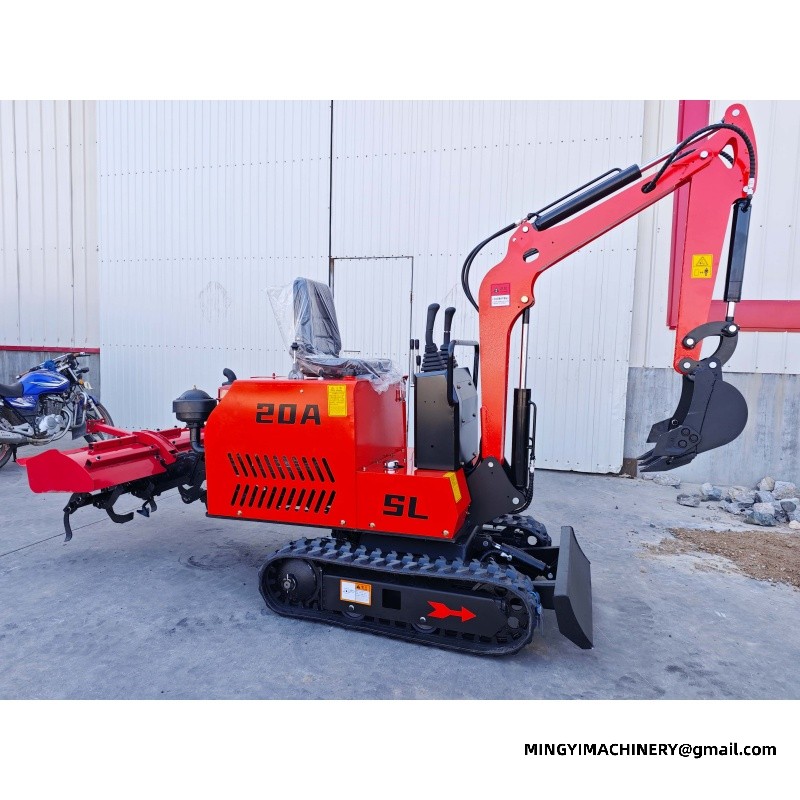
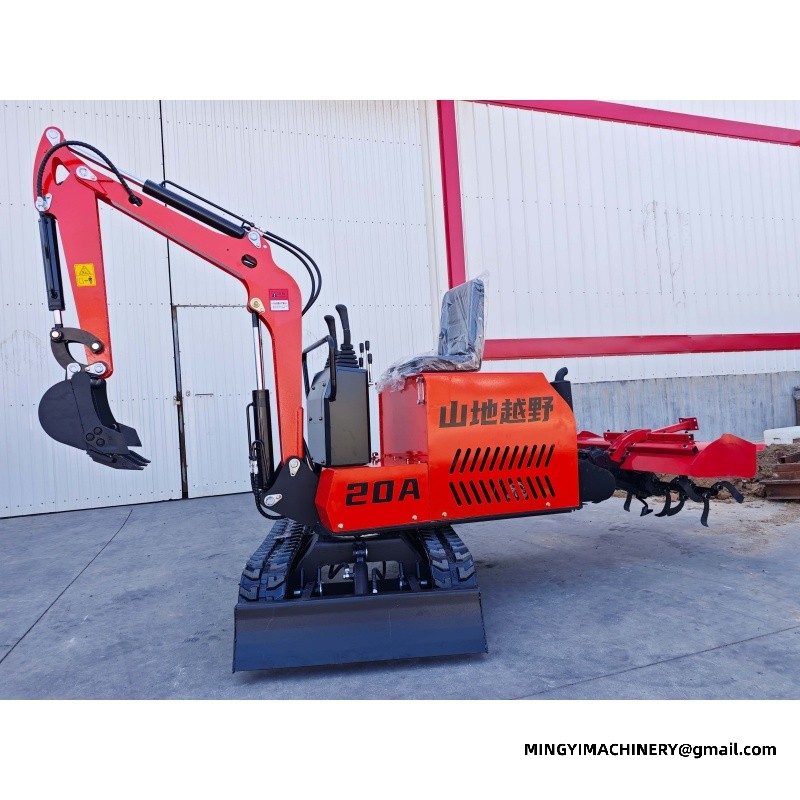
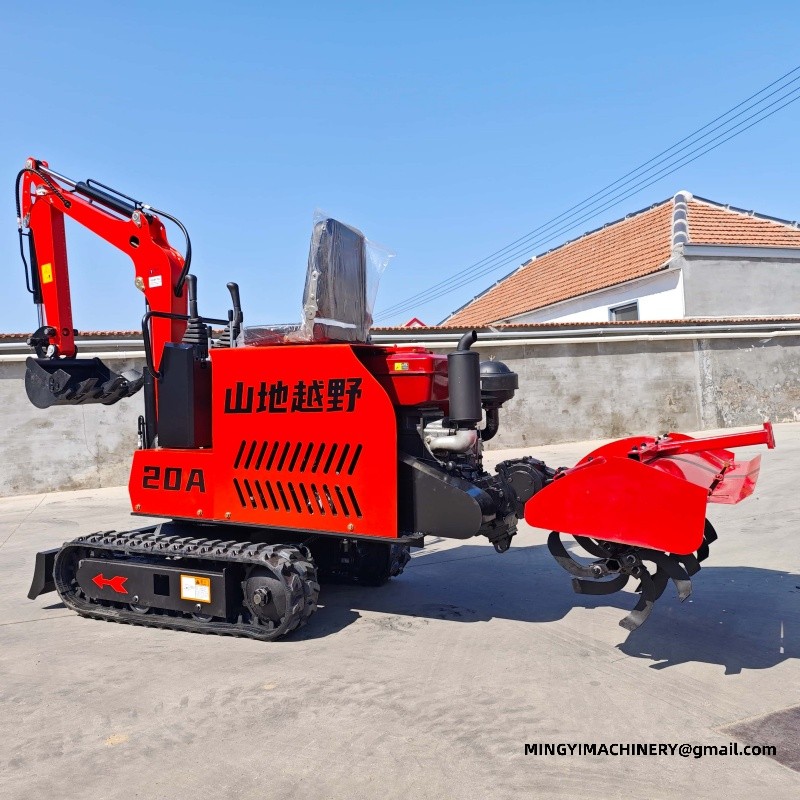
A micro excavator with a crawler rotary tiller attachment combines two duties that smallholders need repeatedly: excavation and soil cultivation. The machine is small enough for tight plots and orchard rows, and tracked so it keeps traction on soft and sloping ground.
MINGYI supplies this combination for horticultural, orchard and small-scale agricultural use.
Two duties, one machine
For excavation the machine takes buckets, a narrow trenching bucket and a breaker hammer, covering drainage, ditch maintenance, planting holes and ground clearance. For cultivation the tracked rotary tiller is fitted and the machine breaks and turns soil ahead of planting.
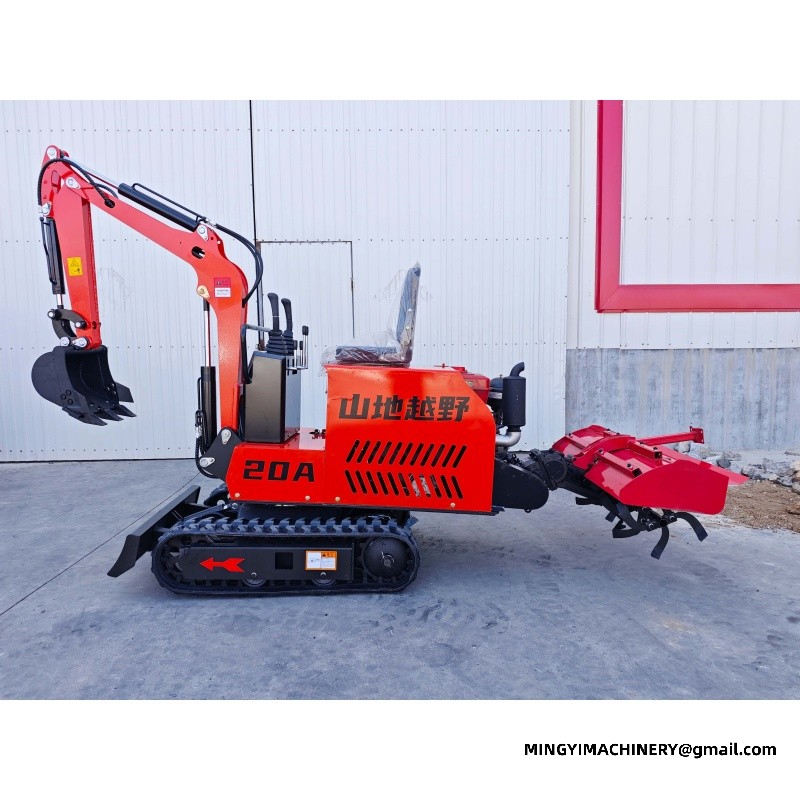
Because the machine is compact, it works between orchard rows and on small plots where a tractor and implement combination cannot manoeuvre.
Why tracked, and why micro
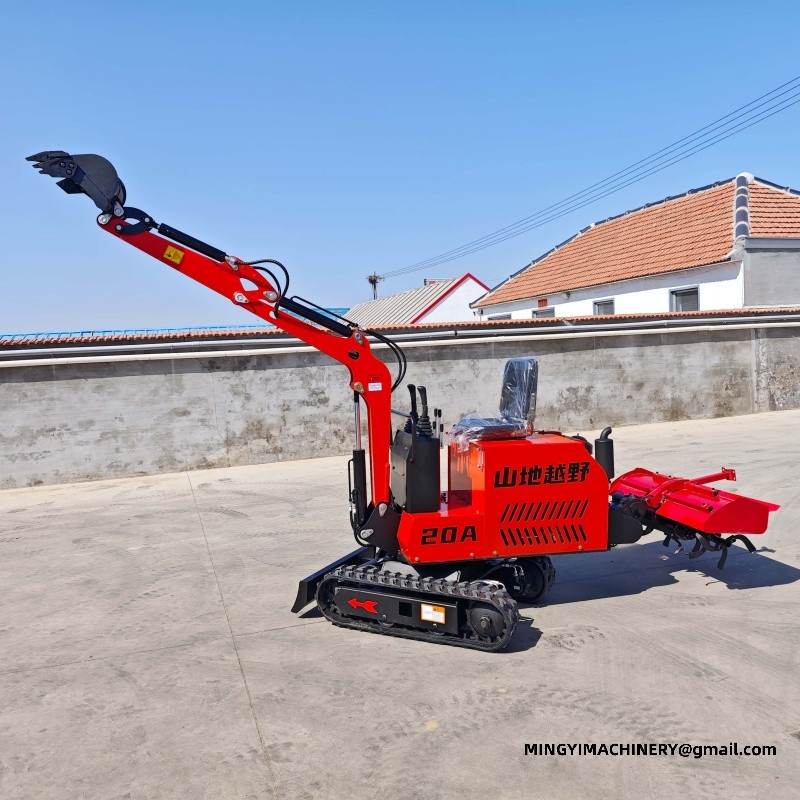
The tracked undercarriage gives traction on soft, wet and sloping ground — the ground on which these small plots are typically found. The micro size keeps the machine transportable and usable in tight areas, and its low weight limits surface damage.
Use on small plots
• Orchard and vineyard row cultivation
• Drainage, ditching and ditch maintenance
• Planting holes and trench preparation
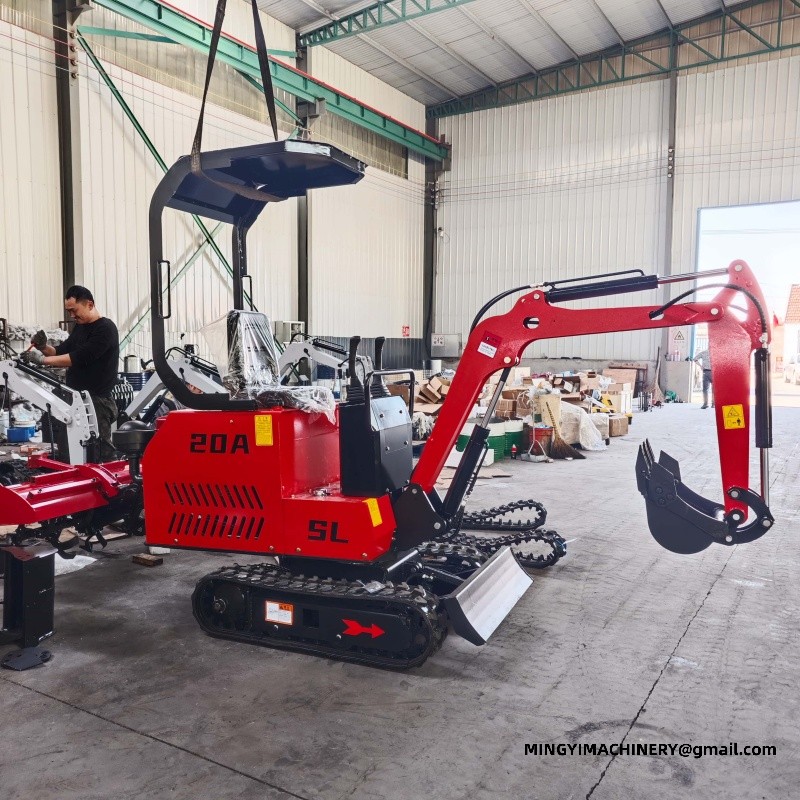
• Soil preparation ahead of planting
• Clearance of scrub and overgrown ground
Tell us the plot, the crop and the ground conditions and we will advise on the machine and tiller specification.
Acceptance checks when a Micro excavator with crawler rotary tiller arrives A function check before the machine goes to work is worth the hour. Running through the controls, the travel and the attachment circuit on this class of machine confirms it is set up as specified and ready for the site. Documentation should arrive with the machine. Parts list, service schedule and any certificates for the unit in daily use are what the workshop needs later, and they are much easier to obtain at delivery than in month six. Working a Micro excavator with crawler rotary tiller through the seasons Seasonal planning smooths the workload. Machines that are busy for a few months and idle for the rest benefit from a service slot in the quiet period, and a machine of this size prepared in the off-season starts the busy months reliably. Heat and dust are as limiting as rain. Air intake condition and cooling cleanliness decide how the equipment on site behaves in a dry season, and both are checked in a minute rather than repaired later. What owners should plan for beyond the Micro excavator with crawler rotary tiller The useful comparison is demand per working hour, not demand per machine. The machine itself that works more hours a year spreads its standing takes over more output, which is why utilisation usually matters more than the invoice figure. Downtime is the hidden line item. The model in question waiting on a part earns nothing while it stands, so parts availability and service access belong in the plan as much as fuel does. Trailering and moving Micro excavator with crawler rotary tiller Transport weight and width decide whether a machine needs a specialist haulier. The machine in that duty sized to travel on a standard plant trailer behind a suitable vehicle moves with the crew rather than on a scheduled low loader. Detachable components reduce transport length. The unit on the job built with a removable arm section or a folding step fits a shorter trailer and may avoid an oversize movement permit. Attachments that turn Micro excavator with crawler rotary tiller into several machines The base machine is a carrier; the tool on the end of the arm decides the task. A machine built for the work fitted with a toothed bucket digs, and the same machine with a breaker, an auger or a grab does work that would otherwise need a second unit on site. Attachment lists are best written before delivery. Specifying the equipment in service with the tools the job list needs avoids the work and delay of adding hydraulics later, and a quick coupler makes the swap a few minutes instead of a workshop job. Interior and light demolition with this class of machine Breaking out a floor slab, a wall footing or a concrete step is routine work for the unit in daily use with a breaker. The machine is small enough to work inside and heavy enough to run the tool at a practical rate. Dust, debris clearance and floor loading all argue for a compact machine indoors. A machine of this size spreads its weight over a wider track footprint than a wheeled machine of similar capacity. Daily checks and maintenance on the equipment on site Daily maintenance on the machine itself is a short list: engine oil level, coolant, track tension, hydraulic oil level and a look at the hoses. Ten minutes at the start of the shift prevents most of the failures that stop a machine. Greasing is the second item. The slew ring, the boom and arm pins and the bucket linkage on the model in question take grease daily in dusty work, and the intervals shorten further when the machine is used in water or mud. Export packing and shipping of the machine in that duty Export documentation, decals and paint are settled before packing. Asking for them with the machine built for the work order avoids a second handling session and keeps the machine on the booked vessel. Buyers who import regularly plan the spare parts with the machine. The unit on the job ordered with a wearing-parts kit arrives ready to work rather than ready to wait for the first service interval. Canopy or enclosed cab on the equipment in service A canopy keeps the machine light and the operator aware of the surroundings, which suits short jobs in warm weather. A fully enclosed cab is specified where rain, dust or cold are part of the working year, and it can be added to this class of machine as a retrofit rather than only at build time. Enclosure also changes noise and dust exposure. A sealed cab on the unit in daily use keeps dust out on dry sites and lets the machine work through weather that would otherwise stop a canopy machine for the day. Orchard, vineyard and farm use of a machine of this size Orchard and vineyard work is carried out between rows. The equipment on site with a narrow chassis and a swing boom works down the row without damaging the trees, which is the reason a full-size machine is not used at all. Farms also use the machine itself for general maintenance - clearing a watercourse, repairing a track, loading a spreader. One carrier with a few attachments covers most of the jobs that would otherwise wait for a contractor. Working the model in question in confined spaces Confined sites are decided by dimensions. Overall width, tail swing and the space needed to work the arm are what let the machine in that duty operate inside a building, between walls or in a courtyard. Ventilation is the other indoor constraint. Running the unit on the job inside a closed structure needs air movement, and that is a planning item rather than something to discover after the first hour. Parts, service and support for a machine built for the work Support after delivery is a parts question. Wearing items for the equipment in service - filters, belts, track components, bucket teeth and pins - are the items a buyer should plan to hold before the first service interval. Engine parts availability usually drives the engine choice. This class of machine built with an engine the local network already carries is serviced from stock rather than from an international order. Specification data for the unit in daily use Buyers comparing a machine of this size usually start from four numbers - weight, digging depth, reach and transport width - because those are the ones that decide whether the machine can be delivered and whether it can do the job once it is there. These are the reference figures for the equipment on site. MINGYI confirms the final build sheet, including engine and attachment choices, against the destination and the job list before production. Rubber tracks suit paved and landscaped ground because they spread the machine weight and leave the surface intact. Steel tracks with rubber blocks are specified where the ground is rougher or the working day is longer, and the choice can be made per machine rather than accepted as a factory default. Undercarriage selection is a ground question, not a preference question. The machine itself running on finished paving needs rubber; the same machine on demolition rubble or rock wears rubber quickly, so steel with rubber blocks becomes the better answer over a full season.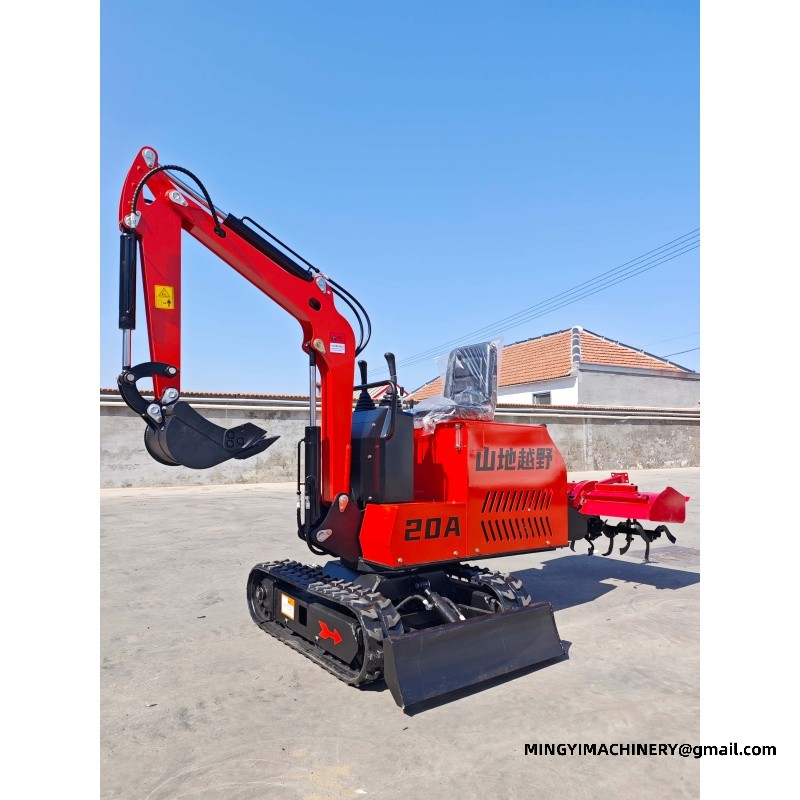
Reference specification — mini excavator range 30-1W 30-2W 20-2L 30-2L Operating weight 2900 kg (6393.41 lb) 2700 kg (5952.48 lb) 1900 kg (4188.78 lb) 2400 kg (5291 lb) Transport size (L×W×H) 3000 × 1250 × 2780 mm 3000 × 1100 × 2700 mm 2600 × 1300 × 2344 mm 2800 × 1500 × 2500 mm Max digging depth 2200 mm (86.61 in) 2200 mm (86.61 in) 2100 mm (82.68 in) 2200 mm (86.61 in) Max digging height 3400 mm (133.86 in) 3000 mm (118.11 in) 2880 mm (113.39 in) 2900 mm (114.17 in) Max dumping height 2400 mm (94.49 in) 2000 mm (78.74 in) 2100 mm (82.68 in) 2100 mm (82.68 in) Max digging radius 4000 mm (157.48 in) 3800 mm (149.61 in) 3215 mm (126.57 in) 3330 mm (131.1 in) Max digging distance 2800 mm (110.24 in) 3050 mm (120.08 in) 2460 mm (96.85 in) 2700 mm (106.3 in) Minimum turning radius 2000 mm (78.74 in) 1750 mm (68.9 in) 1587 mm (62.48 in) 1555 mm (61.22 in) Travel speed 5 km/h (3.11 mph) 7 km/h (4.35 mph) 5 km/h (3.11 mph) 7 km/h (4.35 mph) Gradeability 30° 30° 30° 30° Fuel consumption 2-3 L/h (0.528—0.793 gal) 2-3 L/h (0.528—0.793 gal) 2-3 L/h (0.528—0.793 gal) 2-3 L/h (0.528—0.793 gal) Fuel tank capacity 16 L (4.23 gal) 16 L (4.23 gal) 16 L (4.23 gal) 16 L (4.23 gal) Hydraulic oil tank 20 L (5.28 gal) 20 L (5.28 gal) 18 L (4.76 gal) 18 L (4.76 gal) Dozer blade lift height 420 mm (16.54 in) 230 mm (9.06 in) 180 mm (7.09 in) 230 mm (9.06 in) Dozer blade drop depth 210 mm (8.27 in) 280 mm (11.02 in) 210 mm (8.27 in) 280 mm (11.02 in)
Q. What is a micro crawler tiller used for?
A. Soil preparation in places a wheeled machine cannot reach or cannot work: narrow plots, terraced ground, greenhouse beds and orchard rows. The crawler base spreads the machine weight and holds traction on soft or sloped ground.
Q. Why choose a crawler tiller rather than a walk behind machine?
A. Because of the work rate and the operator. A crawler machine covers ground faster, needs less physical effort, and holds traction where a walk behind machine would need to be pushed on soft or sloping ground.
Q. How do I match a tiller to my plot?
A. Tell us the plot size, the row spacing, the soil and the slope. MINGYI will propose the machine and the tillage attachment that suits those conditions, since both are built to order rather than fixed.
Cold weather and winter care for the model in question
Winter is hard on rubber and on seals as much as on the engine. Parking the machine in that duty under cover, keeping the tracks or tyres off standing water and checking the hoses for cracking are all part of the season.
Keeping a service record for the unit on the job
Service history also protects the warranty position. Evidence that a machine built for the work was maintained at the specified intervals and with the specified fluids settles questions that would otherwise be argued.
E-mail : sales@mingycn.com
LINE ( ID ): mingyicn
Visibility and blind spots around Micro excavator with crawler rotary tiller
Mirrors, cameras and a signal person cover what the seat cannot. Walk the route before the first load and mark the corners where sight is lost.
A machine working in a yard with people on foot needs a rule about who moves first, agreed before the shift rather than during it.
Related pages
mini excavator for garden remodelling · Crawler Tractor with Rear Plough can be rotary tilled and excavated · mini excavator export supply · PRODUCTS









