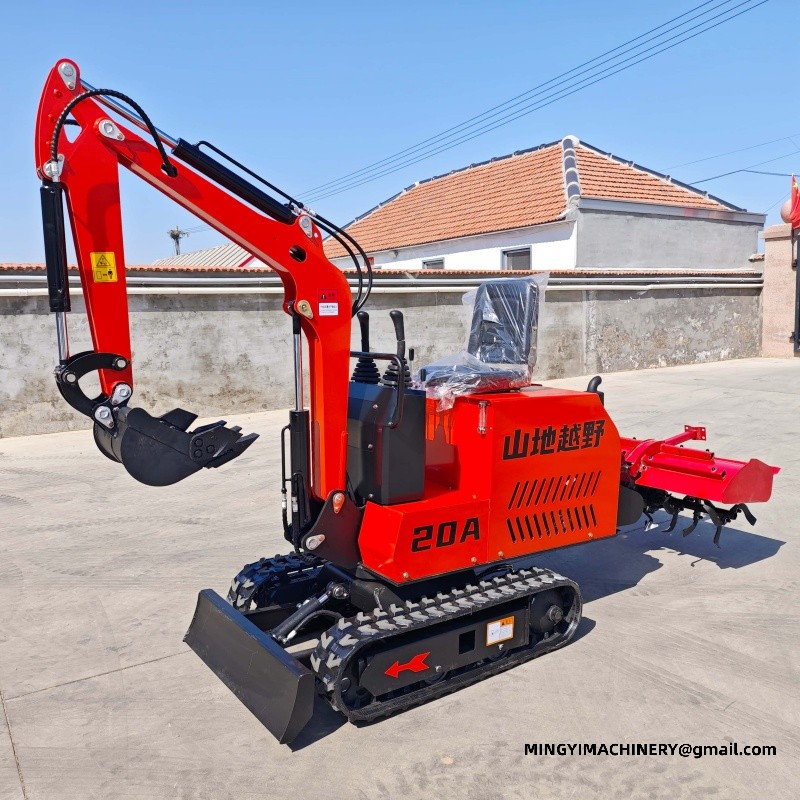
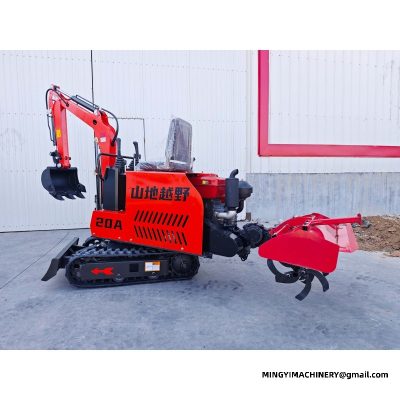
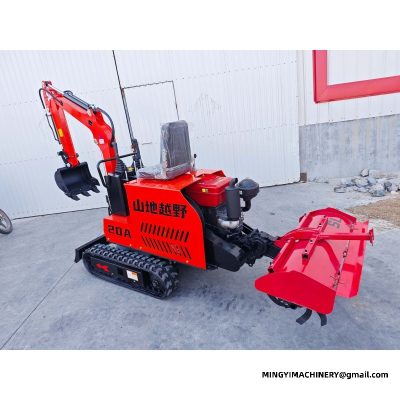
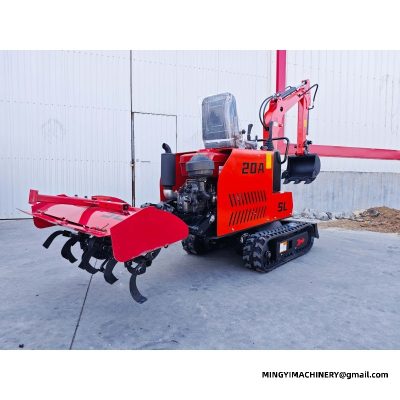
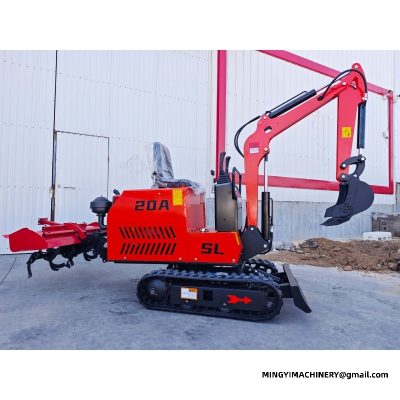
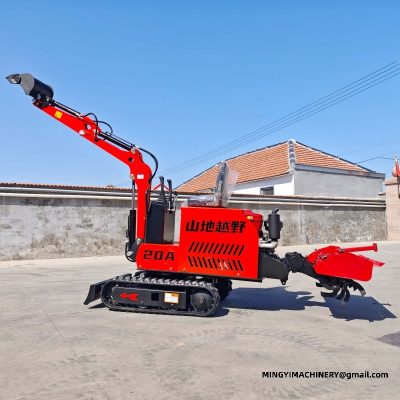
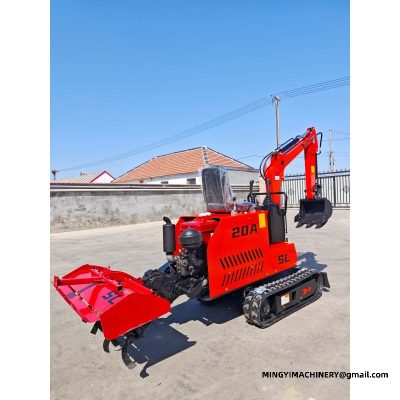
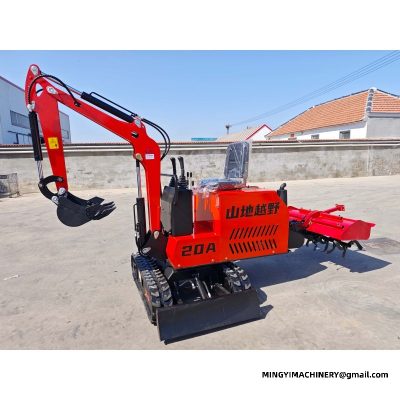
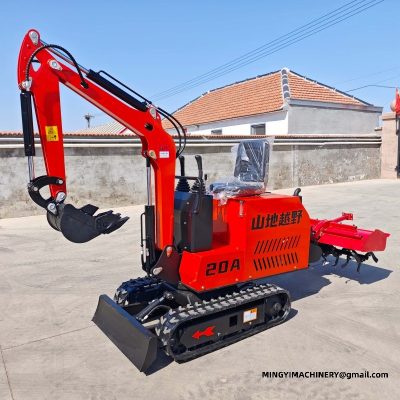
This class of machine extends the machine from groundworks into cultivation. It is a practical option where the same ground needs both drainage and soil preparation, and where buying a separate crawler tractor is not economic.
MINGYI supplies rotary plough attachments and tracked machines that accept them.
What the attachment adds
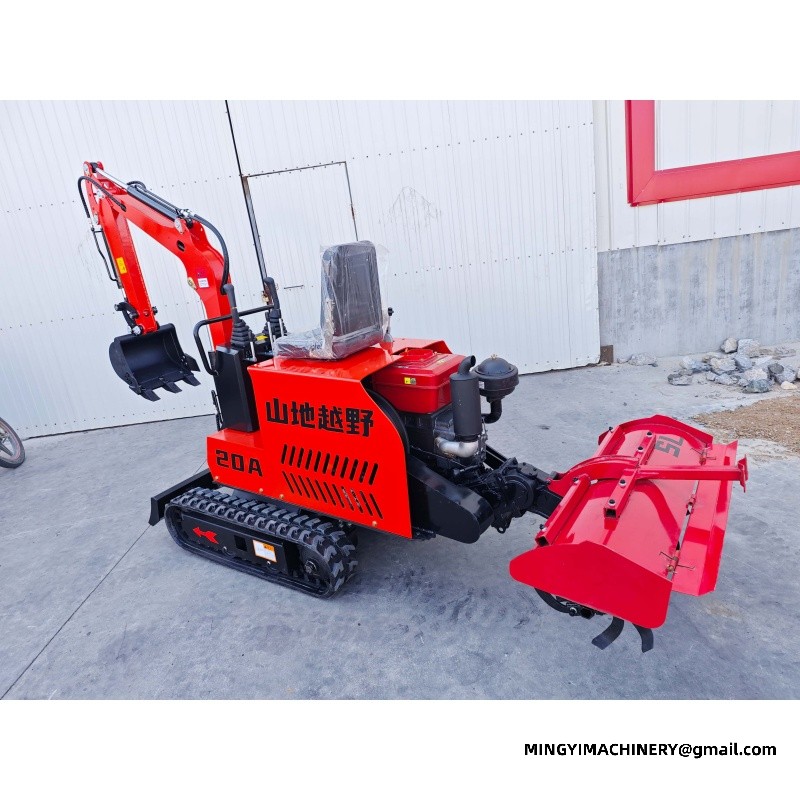
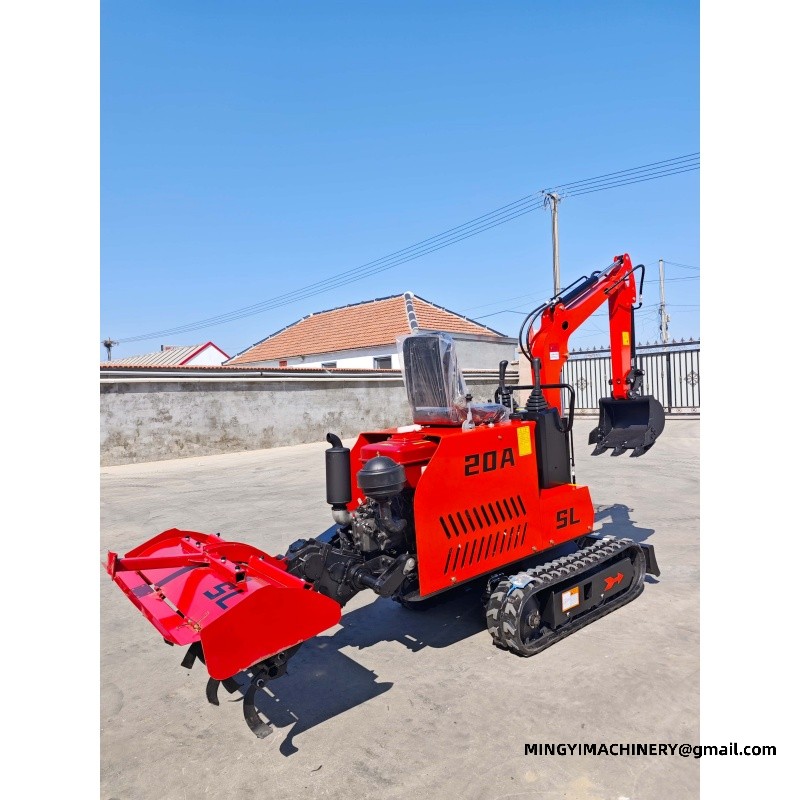
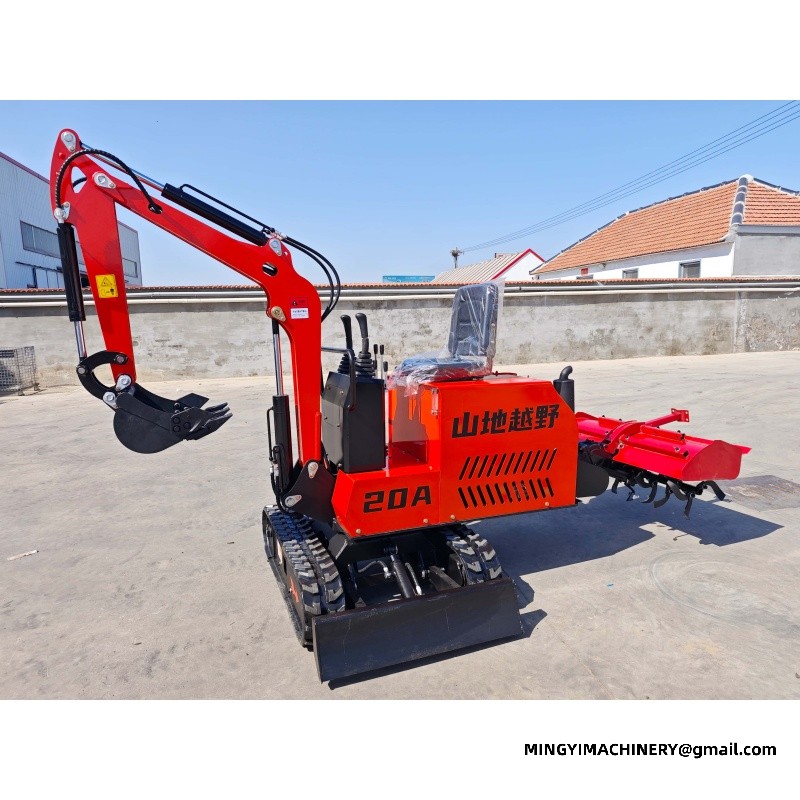
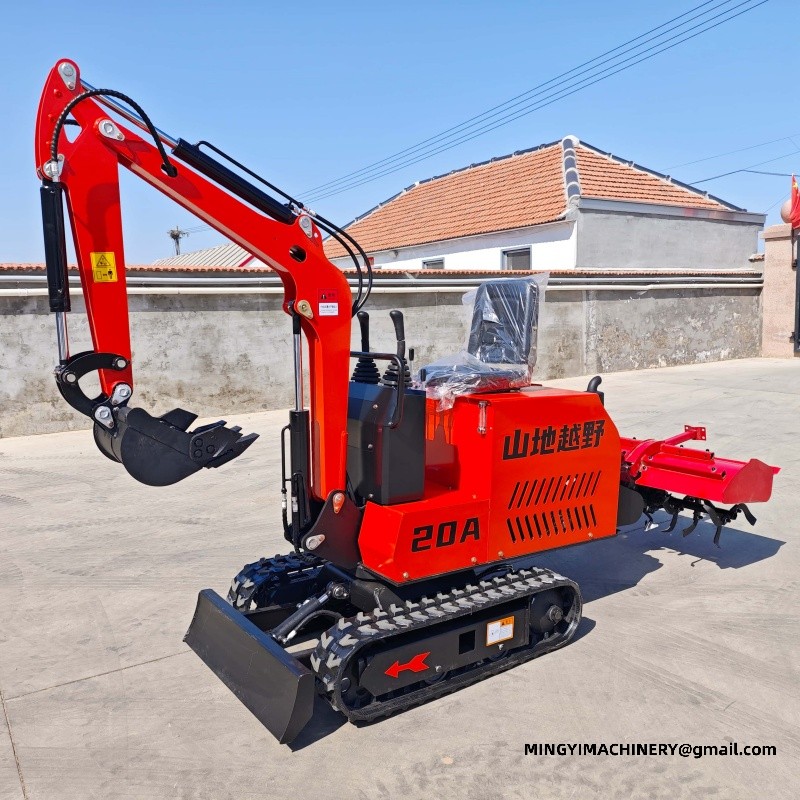
With a rotary plough fitted, the machine breaks and turns soil across the working width, preparing ground for planting. The excavator’s tracked undercarriage supplies the traction, and its hydraulic system drives the attachment, so the plough uses capability the machine already has.
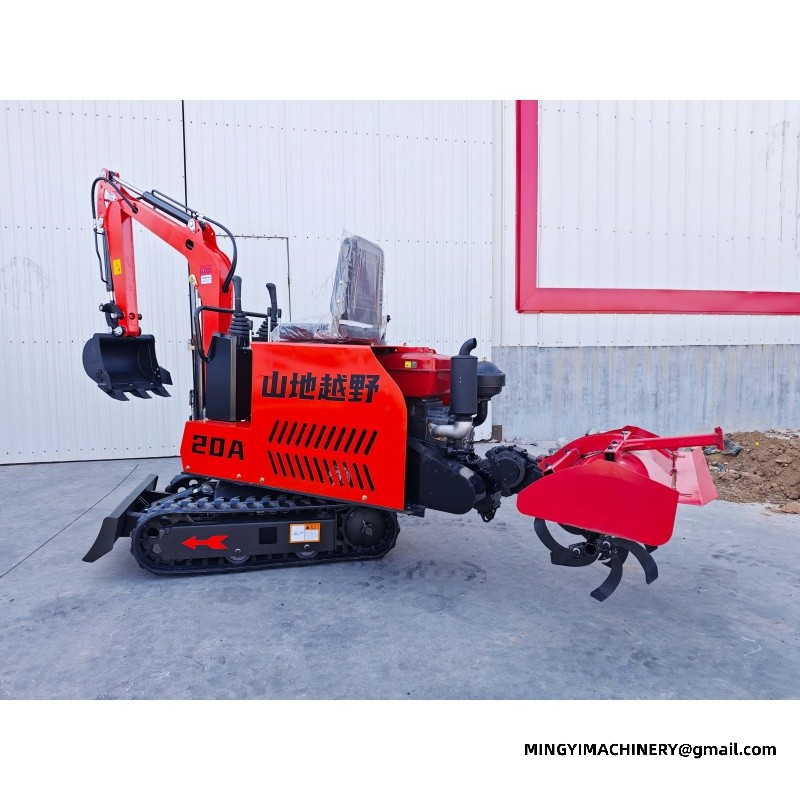
When cultivation is finished, the plough is exchanged for a bucket or breaker and the machine returns to trenching, drainage and clearance work.
Where it is worth fitting
Orchards, vineyards, small plots, terraces and hillside ground, particularly where the ground is soft, wet or sloped. On that ground a tracked machine keeps traction where a wheeled tractor and mounted plough would struggle, and the small machine reaches between rows and into corners.
Attachment benefits
• Cultivation added to an existing excavator
• Uses the machine’s own hydraulics and traction
• Tool change returns the machine to digging
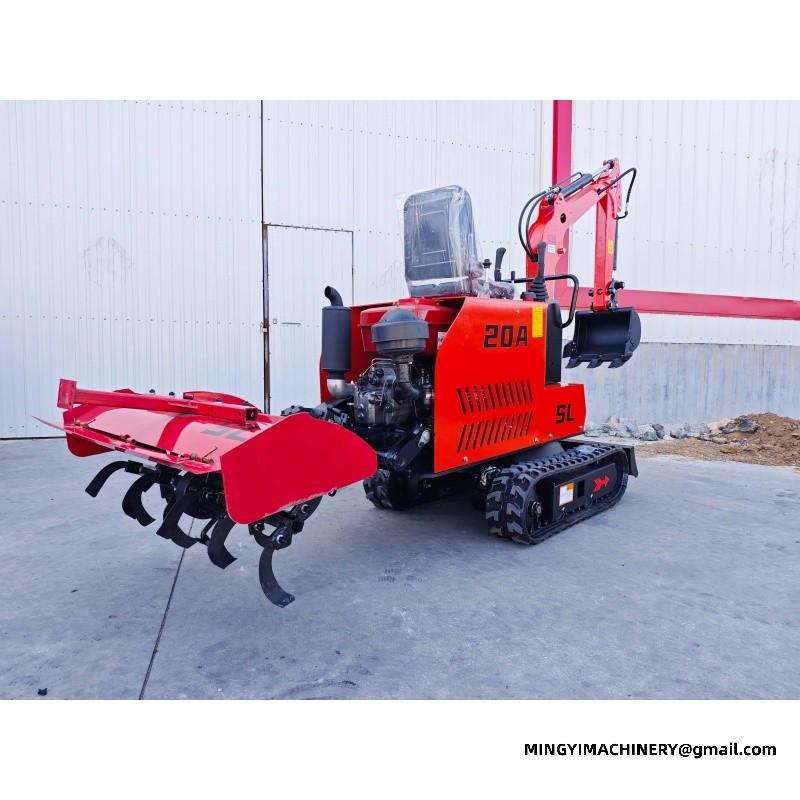
• Effective on soft, wet and sloped ground
• Compact enough for orchard rows and small plots
Tell us your machine model, the crop and the ground and we will confirm the rotary plough specification and fitment.
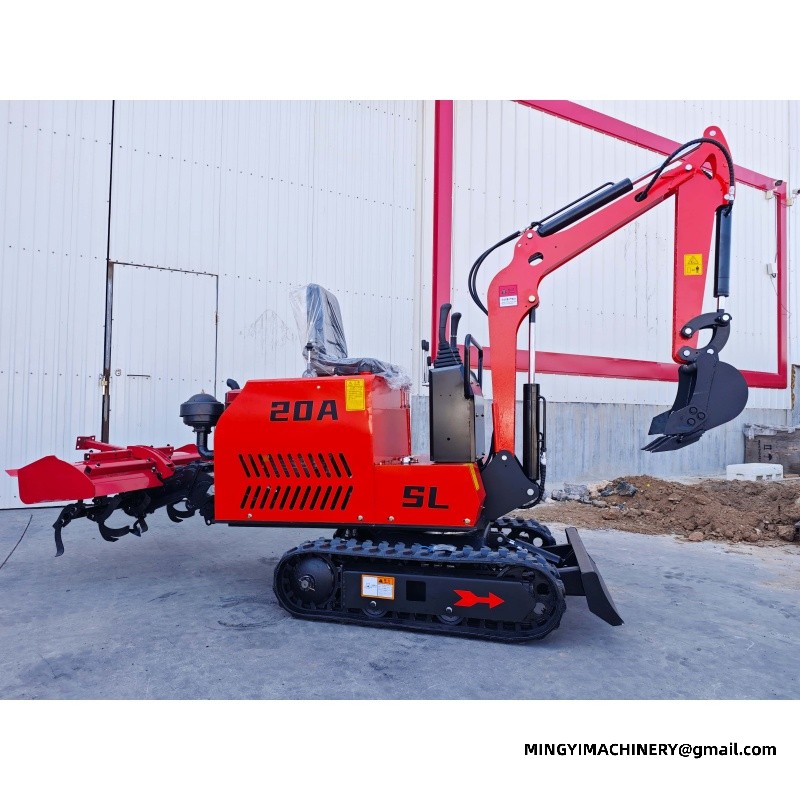
Trenching work with Adding a Tracked Rotary Plough to a Small Excavator Service trenches are the most common reason the unit in daily use is hired. Water, sewage, cable and gas runs are narrow, shallow and often close to existing services, which is exactly the work a full-size machine cannot do safely. Trench quality depends on the bucket width and the operator, not on machine size. A machine of this size with a narrow bucket and a swing boom cuts a clean run along a boundary without disturbing the ground either side of it. What owners should plan for beyond the Adding a Tracked Rotary Plough to a Small Excavator Purchase decision is the visible part of the effort. Fuel, filters, tracks or tyres, the operator and the transport between sites are the items that decide what the equipment on site actually demands over a few seasons, and they are worth listing before the order. The useful comparison is demand per working hour, not demand per machine. The machine itself that works more hours a year spreads its standing takes over more output, which is why utilisation usually matters more than the invoice figure. OEM and fleet customisation of Adding a Tracked Rotary Plough to a Small Excavator Distributors and rental fleets usually need the machine to look like theirs. Paint, decals, seat colour and attachment branding can be specified on the model in question at build time rather than applied after import. Customisation also covers the specification sheet. A fleet buyer may want every machine in that duty delivered with the same coupler, the same engine and the same tool kit so training and parts stock stay simple. Boom configuration for Adding a Tracked Rotary Plough to a Small Excavator A swing boom lets the machine dig parallel to its tracks without repositioning, which is what makes trenching beside a wall or a fence practical. On the unit on the job this is often the option that decides whether a job is possible at all. Detachable boom sections are used where transport length matters. A machine built for the work that has to travel on a standard trailer can be built so the arm comes off for the road and goes back on at the site. Acceptance checks when a Adding a Tracked Rotary Plough to a Small Excavator arrives Delivery day is the best time to find a problem. Checking the specification against the order, the fluid levels, the fasteners and any transport damage while the class of machine is still on the trailer is faster than claiming later. Documentation should arrive with the machine. Parts list, service schedule and any certificates for the equipment in service are what the workshop needs later, and they are much easier to obtain at delivery than in month six. Trailering and moving the unit in daily use Loading practice matters as much as the numbers. A machine of this size is driven up ramps under its own power with the boom lowered and the tracks aligned, and secured at the points the manufacturer specifies. Detachable components reduce transport length. The equipment on site built with a removable arm section or a folding step fits a shorter trailer and may avoid an oversize movement permit. Working near live services with the machine itself The risk on utility work is not machine power but machine placement. The model in question that fits the working width leaves the surrounding ground undisturbed, which keeps the trench stable and the reinstatement small. Utility crews specify the machine in that duty with a narrow bucket and good visibility for exactly this reason: the machine has to stop at the service, not at the edge of the operator's view. Quick coupler practice on the unit on the job A quick coupler is the single option that changes how a machine is used day to day. Fitted to a machine built for the work, it turns an attachment change from a two-person workshop job into a task the operator does alone in minutes. For a fleet that shares attachments between machines, a common coupler standard matters more than the coupler brand. The equipment in service that picks up the same tools as the larger machines keeps the rack usable across the yard. Canopy or enclosed cab on this class of machine A canopy keeps the machine light and the operator aware of the surroundings, which suits short jobs in warm weather. A fully enclosed cab is specified where rain, dust or cold are part of the working year, and it can be added to the unit in daily use as a retrofit rather than only at build time. The cab decision follows the climate and the hours. Operators working a full shift in a machine of this size benefit from a sealed cab with wipers and heating; operators stepping on and off every few minutes usually prefer the canopy for the visibility and the quick exit. Orchard, vineyard and farm use of the equipment on site Orchard and vineyard work is carried out between rows. The machine itself with a narrow chassis and a swing boom works down the row without damaging the trees, which is the reason a full-size machine is not used at all. Ditching, fertilising and drainage on farmland suit the model in question because the work is spread over a large area in short bursts. The machine travels behind a pickup and works where it stops. Specification data for the machine in that duty Buyers comparing the unit on the job usually start from four numbers - weight, digging depth, reach and transport width - because those are the ones that decide whether the machine can be delivered and whether it can do the job once it is there. These are the reference figures for a machine built for the work. MINGYI confirms the final build sheet, including engine and attachment choices, against the destination and the job list before production. Availability is part of the decision. Owning the equipment in service means it is there on the day the ground is ready; hiring means competing for the same machine at the same time as everyone else in the season. Ownership brings obligations that hiring does not. Storage, servicing, insurance and an operator are the items to set against the hire rate before deciding which way this class of machine should be supplied.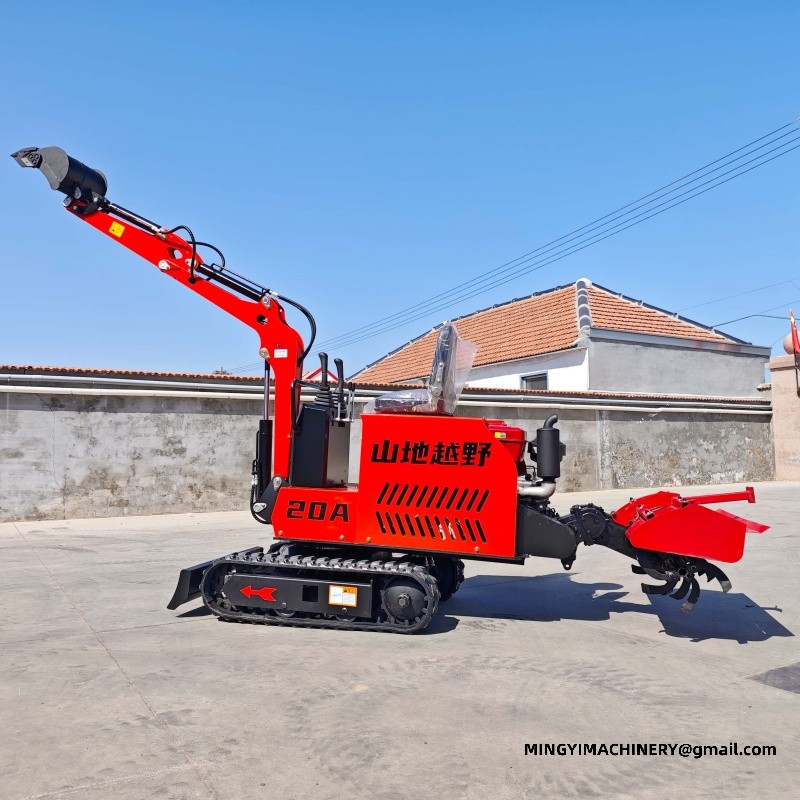
Reference specification — mini excavator range 12W 20-1WL 20-3W 30-2L Operating weight 1200 kg (2645.55 lb) 1900 kg (4188.78 lb) 1900 kg (4188.78 lb) 2400 kg (5291 lb) Transport size (L×W×H) 2200 × 930 × 2250 mm 2550 × 1100 × 2200 mm 2550 × 1100 × 2200 mm 2800 × 1500 × 2500 mm Max digging depth 1630 mm (64.17 in) 1800 mm (70.87 in) 1800 mm (70.87 in) 2200 mm (86.61 in) Max digging height 2750 mm (108.27 in) 2820 mm (111.02 in) 2820 mm (111.02 in) 2900 mm (114.17 in) Max dumping height 1960 mm (77.17 in) 2050 mm (80.71 in) 2050 mm (80.71 in) 2100 mm (82.68 in) Max digging radius 2900 mm (114.17 in) 3050 mm (120.08 in) 3050 mm (120.08 in) 3330 mm (131.1 in) Max digging distance 2100 mm (82.68 in) 2300 mm (90.55 in) 2300 mm (90.55 in) 2700 mm (106.3 in) Minimum turning radius 1300 mm (51.18 in) 1450 mm (57.09 in) 1450 mm (57.09 in) 1555 mm (61.22 in) Travel speed 3 km/h (1.86 mph) 5 km/h (3.11 mph) 5 km/h (3.11 mph) 7 km/h (4.35 mph) Gradeability 30° 30° 30° 30° Fuel consumption 1-1.3 L/h (0.264—0.343 gal) 2-3 L/h (0.528—0.793 gal) 2-3 L/h (0.528—0.793 gal) 2-3 L/h (0.528—0.793 gal) Fuel tank capacity 10 L (2.64 gal) 16 L (4.23 gal) 16 L (4.23 gal) 16 L (4.23 gal) Hydraulic oil tank 16 L (4.23 gal) 18 L (4.76 gal) 18 L (4.76 gal) 18 L (4.76 gal) Dozer blade lift height 180 mm (7.09 in) 180 mm (7.09 in) 180 mm (7.09 in) 230 mm (9.06 in) Dozer blade drop depth 210 mm (8.27 in) 210 mm (8.27 in) 210 mm (8.27 in) 280 mm (11.02 in)
Q. What is a tracked rotary plough on a small excavator?
A. It is a rotary plough attachment fitted to a compact crawler machine so the same carrier can prepare soil as well as excavate. MINGYI matches the attachment to the machine's hydraulic circuit when the order is placed.
Q. Which ground suits a tracked plough?
A. Orchard rows, terraces, greenhouse beds and small plots where a wheeled tractor cannot be driven or cannot turn. The crawler base spreads the weight and holds traction on soft and sloped ground.
Q. Can the machine still dig once the plough is fitted?
A. Yes, if it is ordered with a quick coupler, because the plough can then be exchanged for a bucket set on site. Order the coupler and the full tooling list together so both functions are covered from the start.
Wear items and spares worth holding for the unit in daily use
The parts that stop a machine are rarely the parts that are hardest to find. Filters, belts, seals and the ground engaging tools on a machine of this size are easy to hold and slow to replace, which is why they belong on the shelf rather than on an order.
Documents that travel with the equipment on site
Documentation should match the machine that was actually built. The sheet supplied with the machine itself records the configuration as delivered, because the generic catalogue description is not what the customer needs when ordering a part.
Planning the season around the model in question
Workload is rarely even across the year, and the machine should be specified for the busy weeks. The machine in that duty sized only for the average month will be the limiting factor exactly when the work is worth the most.
E-mail : sales@mingycn.com
LINE ( ID ): mingyicn
Water, mud and recovery planning for Adding a Tracked Rotary Plough to a Small Excavator
Water is the enemy of bearings, electrical connectors and anything that is supposed to be sealed, and it rarely announces where it got in.
Wading to the hub, the track frame or the axle line is a limit rather than a target, and it is printed in the manual for a reason.
Planning the exit route before entering soft ground takes less time than planning the recovery afterwards.
Working alongside other plant with Adding a Tracked Rotary Plough to a Small Excavator
Exclusion zones drawn on the ground work better than zones described in a meeting, and they are re-drawn when the job phase changes.
Radio discipline saves more time than any other single measure, and one channel with agreed words is enough.
Where two machines share a bench or a stockpile, the newer operator is paired with the experienced one for the first shift.
Related pages
Modification of Excavator to Rotary Plough · Modification of Mini-Miner to Rotary Ploughing Machine · oem mini excavator supply · PRODUCTS









